




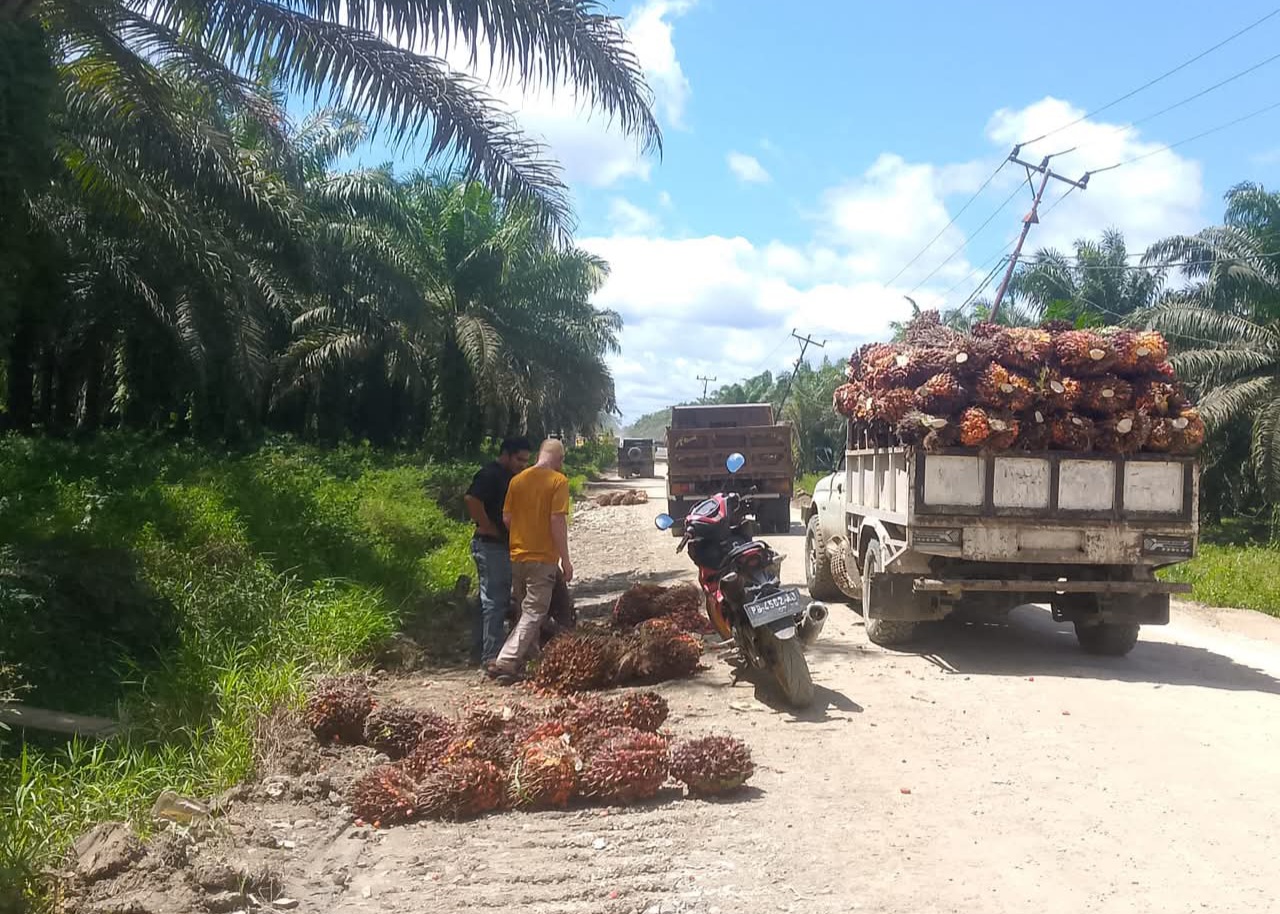
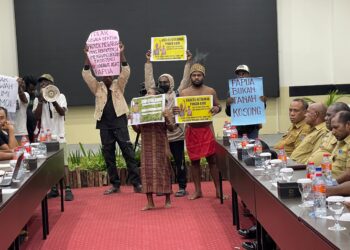
Sorong, Jubi – Residents in Sorong Regency, Southwest Papua, have protested against palm oil company PT Inti Kebun Sejahtera (IKS) for continuing to harvest palm fruit on land that remains under dispute in Klalik Village, Klaso District.
One resident, Roy, said the community was disappointed that the company had continued its operations despite ongoing objections from landowners.
“Since January, we have maintained a blockade on the area as a form of protest because our concerns and rights have never been properly addressed. Yet the company continues to enter the disputed land and harvest palm fruit as if there were no problem,” Roy said on Sunday.
According to Roy, the community initially agreed to allow the company to use the land for a nursery. However, residents later alleged that the company expanded its activities and converted the area into a palm oil plantation without obtaining consent from the customary landowners.
He said the dispute dates back to 2006, when the company began clearing land in several plots that formed part of community-owned plasma plantation areas. The clearing, he claimed, was carried out without prior notification to local residents who held rights to the land.
Roy said residents sought compensation of Rp150 million during mediation efforts held in February 2026. The figure was calculated based on the company’s use of the land from 2006 to 2025.
During negotiations, the community later reduced its demand to Rp250,000 per hectare per month for an agreed period.
“We have tried to find a compromise. Initially, we requested Rp150 million based on nearly two decades of land use. We later reduced our demand to Rp250,000 per hectare per month and even agreed to limit compensation calculations to the company’s operations between 2020 and 2025. However, our demands have yet to be addressed,” Roy said.
In addition to compensation issues, residents have questioned the lack of clarity regarding land boundaries, arguing that a transparent verification process involving Indonesia’s National Land Agency (BPN) is necessary.

Community members have repeatedly requested a new land survey to verify the legal boundaries between community-owned land and areas claimed by the company. According to residents, that request has not been fulfilled.
“People are asking why an area that 400 hectares was once around, is now shown on maps as only about 260 hectares. What happened to the rest of the land? The company must explain what happened to that land,” Roy said.
The disputed land is located within a former transmigration settlement area established in 1988, where approximately 200 transmigrant households were allocated land by the government.
Roy said each household originally received about two hectares, bringing the total distributed area to roughly 400 hectares.
“Today, much of that land is under dispute, and some of it has been reclaimed by Indigenous communities,” he said.
He added that residents have pursued various avenues to resolve the conflict, including dialogue and mediation, but no definitive solution has been offered by the company.
Residents are now urging both the Sorong Regency administration and the central government to intervene in what they describe as a long-running agrarian conflict.
They argue that government involvement is essential to prevent the dispute from escalating further and to ensure that the company ceases operations on the contested land until community grievances have been resolved in accordance with the law.
“We are not opposed to investment. However, investment should not come at the expense of people’s rights,” Roy said.
“We remind PT Inti Kebun Sejahtera not to continue harvesting on land whose legal status remains disputed. We will continue defending our rights until there is clarity and justice.”
Meanwhile, Ambrosius Klagilit of the Papua Legal Aid Institute (LBH Papua Pos) in Sorong said the issue should not be treated as an ordinary land dispute but as a matter involving the fundamental land rights of local communities.
“The state must not allow a company to continue profiting from land whose ownership and status are still being challenged by the community,” Klagilit said.
He argued that the company should suspend all activities in the disputed area until a fair and transparent resolution is reached.
“If there are still unresolved objections and demands from the community, company operations should be temporarily halted until a lawful and transparent settlement is achieved,” he said.
Klagilit added that both regional and national governments have a legal obligation to ensure that business activities do not undermine community rights.
According to him, allowing the conflict to continue unchecked would reflect weak state oversight of problematic investment practices.
He further warned that if residents’ demands continue to be ignored, LBH Papua Pos Sorong will pursue legal action and advocacy efforts measures to safeguard community rights. (*)
















Discussion about this post