





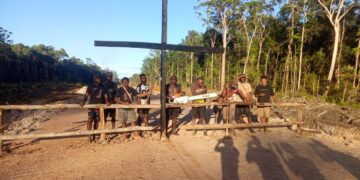
Jayapura, Jubi – The Papua Legal Aid Institute (LBH Papua) in Merauke has urged President Prabowo Subianto to instruct the Indonesian Military (TNI) Commander to end military involvement in the Indigenous land dispute involving the Kamuyend clan in Merauke Regency, South Papua, and to respect both the crosses erected by Indigenous communities as blockade markers and the order issued by the Jayapura State Administrative Court (PTUN).
Director of LBH Papua Merauke, Teddy Wakum, said that on 24 May 2026, his office received reports alleging the mobilization and involvement of Indonesian Army (TNI-AD) personnel to dismantle blockade actions carried out by the Kamuyend Indigenous clan in Nakias Village, Ngguti District, Merauke Regency, South Papua Province.
According to Wakum, the involvement of military personnel has created fear among Indigenous customary landowners and reflects military intervention in civilian and public security affairs that should be handled by the police.
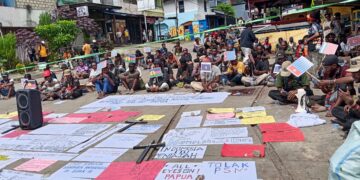
Based on reports received by LBH Papua Merauke from local residents, around 10 fully armed soldiers arrived at the blockade site in military vehicles on 23 May 2026.
The soldiers reportedly questioned the use of crosses as blockade markers against the construction of a 135-kilometer road project crossing customary lands of the Kamuyend clan.
The Kamuyend clan had previously erected crosses in the area on 8 October 2025 as symbol prohibiting any form of activity on the land.
“However, in reality, there were parties who deliberately removed the crosses without coordination with the Kamuyend clan, while land-clearing activities continued,” Teddy Wakum said in a written press release on Friday (29/5/2026).
He said the TNI-AD personnel questioned the reasons for the blockade and the reinstallation of the crosses. Representatives of the Kamuyend clan explained that, as customary landowners, they rejected the presence of companies and National Strategic Projects (PSN) on their ancestral lands.

“The blockade of the 135-kilometer road project is in accordance with an order from the Chief Judge of the Jayapura State Administrative High Court (PTUN), directing the defendant [the Merauke Regent] that no activities may take place in the disputed area until a legally binding ruling has been issued,” he said.
As legal counsel for the Kamuyend clan, LBH Papua Merauke stressed that since the project began, the clan had consistently expressed firm opposition, which was witnessed directly by the Governor of South Papua during a working visit to Nakias Village in 2025.
LBH Papua Merauke emphasized that all parties are obliged to respect the Kamuyend clan’s decision in accordance with human rights principles.
According to Wakum, the blockade constitutes a peaceful form of protest because both the regional government and the company allegedly failed to uphold the principle of Free, Prior, and Informed Consent (FPIC) as mandated under Law No. 39/1999 on Human Rights.
“In principle, the Kamuyend clan’s actions are guaranteed under Article 18B paragraph (2) of the 1945 Constitution, Article 43 of Law No. 2/2021, and Constitutional Court Decision No. 35/PUU-X/2012 affirming that customary forests are not state forests,” he said.
LBH Papua Merauke argued that the involvement of the TNI in business investment projects such as the 135-kilometer road project not only contradicts the professionalism of the military — which is mandated not to engage in business activities and to uphold human rights under Article 2(d) of the TNI Law — but also created the potential for future human rights violations against the Malind Indigenous community.
Furthermore, the organization said the military’s involvement in securing the road project contradicts the TNI’s constitutional role as a state defense institution tasked with addressing military and armed threats against national sovereignty, territorial integrity, and public safety, as stipulated under Articles 5 and 6 paragraph (1)(a) of the TNI Law.
The presence and involvement of TNI-AD personnel were also described as inconsistent with the military’s principal duties under Article 7 of the TNI Law, because participation in the road project could not be categorized as a Military Operation Other Than War (OMSP), which requires prior political authorization and state policy decisions involving both the government and the House of Representatives (DPR).
LBH Papua Merauke therefore urged the Indonesian President to immediately instruct the TNI Commander to ensure there is no involvement of TNI-AD personnel in the Kamuyend Indigenous land conflict in Merauke and to respect the cross-blockade action carried out by the community.
The organization also called on all parties to comply with and implement the order of the Jayapura State Administrative Court judges to halt all land-clearing activities in the customary territory of the Kamuyend clan.
In addition, LBH Papua Merauke urged Commission I of the Indonesian House of Representatives, as part of civilian oversight of the military, to evaluate all TNI actions that contradict its official role, duties, and functions, particularly military involvement in national strategic projects. (*)















Discussion about this post