





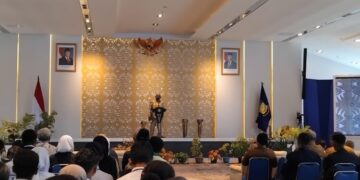
Teminabuan, Jubi – Eight indigenous youth communities have been established in Sorong Selatan following a five-year consolidation process aimed at strengthening customary communities and protecting indigenous territories. The Knasaimos Customary People Council (DPMA) officially endorsed the formation of the Bol Blen Community of the Ogit/Yaben tribe during a declaration ceremony held in Knaya Village, Seremuk and Saifi Districts, South Sorong Regency, on Tuesday (May 6, 2026).
The newly recognized indigenous youth communities are the Sadir Wet Yifi Community, Sanggar Bol Wyong Community, Kna Mlas Community of the Kna sub-tribe, Tival Community of the Imian sub-tribe, Slouw Bailo Kamas Community of the Srer sub-tribe, Wet Saris Yehin Community of the Salmit Klausa sub-tribe, Bol Saris Community of the Saifi sub-tribe, and the Bol Blen Community of the Ogit/Yaben tribe.
Chairperson of the Knasaimos Indigenous Youth Community, Nabot Sreklefat, said the establishment of the communities marked an important milestone in the struggle of indigenous youth to safeguard the existence of the Knasaimos customary territory amid growing threats to forests and natural resources in Tanah Papua.
“On February 21, 2024, we declared the Knasaimos Indigenous Youth Community. Through a long process of consolidation until today, we have successfully established and organized eight indigenous communities across the Knasaimos customary territory,” Sreklefat said in a press statement on Tuesday.
He also stated to the public and all indigenous communities of the greater Tehit and Ogit/Yaben tribes that the consolidation process behind the establishment of indigenous youth communities in the Knasaimos customary territory was not merely the creation of an ordinary organization.
It is also part of a broader movement of indigenous youth committed to protecting people, forests, seas, and the environment in Tanah Papua, particularly within Knasaimos territory.
According to Sreklefat, the formation of the communities emerged from growing awareness among indigenous youth regarding ongoing threats facing their ancestral lands.
“The communities that have been formed will become spaces for consolidation and collective struggle to defend customary forests for the future of indigenous peoples,” he said.

He explained that the main objective of the initiative is to protect, preserve, and sustain customary forests in Knasaimos, with a vision of safeguarding Papua’s indigenous forests for future generations.
Sreklefat noted that the establishment of the Bol Blen indigenous community was the result of a lengthy process. For three years, indigenous youth carried out consolidation efforts in villages before the community was officially endorsed.
“This Bol Blen indigenous community is part of the long struggle of indigenous youth. We went through a very long consolidation process. Therefore, I would like to thank all parties who supported us, including DPMA Knasaimos, assisting NGOs, churches, government institutions, and customary leaders,” he said.
He described the Bol Blen community as a symbol of unity among Ogit/Yaben youth in their efforts to rise, lead, and protect their customary lands through ancestral local systems.
The establishment of the community is also seen as a key step toward organizing indigenous youth within the larger Yaben tribal group and uniting the aspirations of the younger Ogit/Yaben generation to become self-reliant leaders capable of preserving natural resources through sustainable local systems.
Sreklefat expressed hope that the eight indigenous youth communities, now under the umbrella of AMAK, would remain consistent in serving as the frontline defenders of Knasaimos customary territory against threats that could damage forests and indigenous livelihoods.
He said indigenous communities in Knasaimos have grown increasingly concerned over the rising number of investors entering customary territories in South Sorong without fully involving indigenous peoples in decision-making processes.
Sreklefat urged the South Sorong Regency Government and the Papua Barat Daya Provincial Government to stop issuing permits indiscriminately to investors and not turn indigenous forests and ancestral lands into sites of exploitation that benefit corporations while depriving indigenous communities of their living space.
According to him, large-scale investment projects often result in environmental destruction, social conflict, and the erosion of indigenous land and forest rights that have been protected for generations by customary landowners.
“The forests of South Sorong are not empty land. Inside them are sago groves, water sources, hunting grounds, sacred sites, and the lives of indigenous peoples. If the government continues opening unlimited access for investors, one day indigenous communities will become mere spectators on their own land,” he said.
He stressed that local governments should prioritize strengthening indigenous community-based economies rather than continuing to promote investments that risk damaging forests and ecosystems in Knasaimos and other customary territories in South Sorong.
“We indigenous youth are not against development, but development must respect indigenous peoples and protect nature. Investment should not become an excuse for forests to be cleared, rivers destroyed, seas polluted, and indigenous communities marginalized from their ancestral lands,” Sreklefat said.
He affirmed that Knasaimos indigenous youth would stand at the forefront in defending their customary territories from forms of natural resource exploitation viewed as threatening the future survival of indigenous communities.
“My hope is that these eight indigenous youth communities will continue to exist in protecting forests, seas, air, and people within the Knasaimos customary territory in line with the vision and mission of DPMA Knasaimos. From these communities, strong young indigenous leaders will emerge and become the frontline defenders of their ancestral lands,” Sreklefat said. (*)









Discussion about this post