




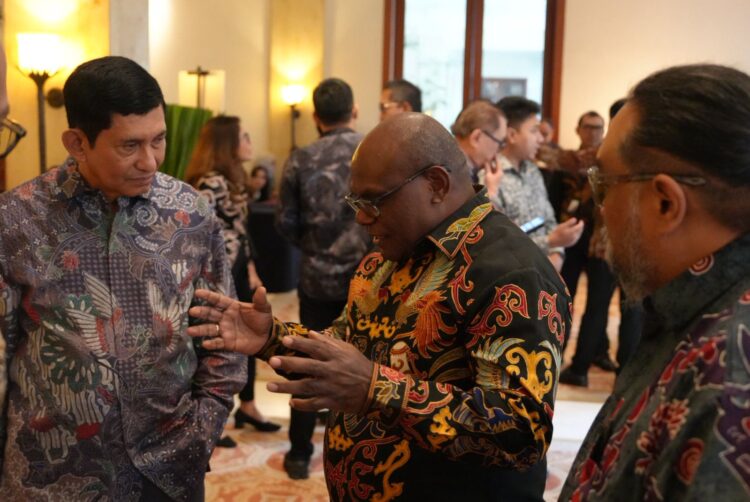
Jayapura, Jubi – Central Papua Governor Meki Nawipa said he will instruct authorities to take action against the growing number of illegal gold mining operations in the province. The move comes in response to concerns that such activities are causing environmental damage and harming Indigenous communities in Central Papua.
Nawipa made the statement in a written press release after serving as a keynote speaker at a focus group discussion themed “Upstream-Downstream Integration Strategy for Gold Reserve Management Towards Sovereign Monetary Resilience,” held at a hotel in Jakarta on Tuesday (May 5, 2026).
“Upon returning from Jakarta, I will instruct the Central Papua Energy and Mineral Resources Office (ESDM) to take action against all illegal mining activities. We want the best outcome and must bring order to everything,” Nawipa said.
He noted that illegal mining not only damages ecosystems and disadvantages Indigenous communities, but also results in lost regional revenue.
In addition, such activities are often linked to conflicts among local groups, disrupting long-standing social and cultural ties.
“In several areas of Central Papua, communities that once lived closely together are now divided. There have even been inter-tribal conflicts. This cannot be allowed to continue. It must be brought under control and properly regulated,” he said.
Nawipa stressed the need to organize mining activities in the province, noting that many operations currently lack permits.
He said he would instruct relevant agencies to crack down on unlicensed gold mining (PETI) to prevent environmental degradation and curb potential financial losses for both the government and Indigenous communities.

“We already have data on the number of sites and their locations. The key point is that we will take action as soon as possible,” he added.
Nawipa warned that illegal mining carries criminal penalties, including up to five years in prison and fines of up to Rp100 billion.
He added that sanctions also apply to those who collect or trade illegally mined gold, in accordance with Law No. 4 of 2009 on Mineral and Coal Mining.
According to Nawipa, if all mining activities were properly licensed, the sector could significantly contribute to economic growth.
“It would improve public welfare, create jobs, and increase both regional and national revenue. But with illegal mining like this, the benefits are limited and not shared by all,” he said. (*)











Discussion about this post