





Teminabuan, Jubi – The Indigenous Nasawat community in South Sorong Regency, Southwest Papua, has rejected a village forest scheme currently being formulated by the local regency administration.
The rejection was expressed by members of the Indigenous Community Institution (LMA) Nasawat, together with Indigenous youth groups, Wsan Kmindin, the Indonesian Christian Student Movement (GMKI), and the Indonesian National Student Movement (GMNI) of South Sorong Regency, during a visit to the South Sorong Regional Development Planning Agency (Bappeda) office on Friday (22/5/2026).
The Indigenous Nasawat community opposes the scheme because the government is considered to have unilaterally included their customary territory in the village forest and social forestry schemes without the consent of Indigenous customary landowners.
They demanded that the government immediately halt all processes related to drafting social forestry documents in the Nasawat Sawiat Raya customary territory.
The village forest scheme is viewed as a new form of state control over customary land that Indigenous communities have protected for generations without state intervention.
Deputy Chairperson I of LMA Nasawat, Marten Saflela, stressed that the Indigenous Nasawat Sawiat Raya community is defending its customary forest based on Constitutional Court Decision No. 35/PUU-X/2012, which affirmed that customary forests are no longer classified as state forests.
“We, the Indigenous Nasawat Sawiat Raya community, firmly state that customary forests are ancestral heritage that we have protected for generations,” Marten Saflela said.
He said the state must not take or designate their customary territory without the consent of Indigenous customary rights holders.

“The areas now included in the village forest scheme cover thousands of hectares of customary land in Wehali Village, Magis Village, Sfakyo Village, and the Ween area, all of which were included without consultation or approval from Indigenous communities,” he said.
According to him, around 4,989 hectares in Wehali Village have been included in the village forest scheme, along with 1,692 hectares in Magis Village, approximately 5,000 hectares in Sfakyo Village, and around 2,537 hectares in Ween.
He said Indigenous communities are fighting for full recognition of customary forests as inherent Indigenous rights passed down from their ancestors.
Meanwhile, GMKI South Sorong Chairperson Gofon Arky Lemauk said his organization stands alongside the Indigenous Nasawat community in protecting customary forests from policies that ignore Indigenous rights.
According to him, the state must not make unilateral decisions without listening to the voices of customary landowners.
“The government cannot speak about development while trampling on Indigenous rights,” Gofon Lemauk said.
He said the issue of customary forests in Papua is not merely an administrative matter, but also concerns Indigenous identity, history, livelihoods, and the future of communities that have protected forests for generations without destroying them.
Therefore, he argued, the state is obliged to respect Indigenous peoples as the primary actors in forest management in the Land of Papua. For Indigenous communities, forests are not merely timber and land, but a mother that sustains life.
“When the state enters without the consent of Indigenous communities, it is essentially taking away the lives of Papuan Indigenous peoples. This is what we are fighting against together,” he said.
Lemauk also highlighted the government’s weak public outreach regarding social forestry regulations in Southwest Papua. He said if Indigenous communities reject the scheme, it indicates flaws in the process.
He argued that many government policies are made without understanding the realities faced by Indigenous communities in villages, resulting in state programs that instead create new conflicts within Indigenous societies.
“We will not remain silent. GMKI, together with Indigenous communities, will continue to speak out until the state fully recognizes customary forests as Indigenous rights,” Lemauk said.
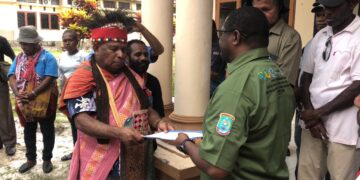
Meanwhile, Head of the Watershed Management and Social Forestry Division at the Southwest Papua Environment, Forestry, and Land Agency, Sarteis Yulian Sagrim, acknowledged while receiving the community’s demand that the provincial government had not conducted sufficient public outreach regarding the social forestry scheme.
“We acknowledge that the provincial government has weaknesses because it has not conducted comprehensive outreach regarding Law No. 11 of 2021 and social forestry regulations. That is our weakness,” Sagrim said.
According to him, the provincial government is only implementing regulations issued by the central government, including policies related to social forestry schemes established through various national regulations.
However, the explanation was not fully accepted by the Indigenous communities. Protesters insisted that the village forest and social forestry schemes would instead become an entry point for state control over customary territories without full recognition of Indigenous rights.
They urged both central and regional governments to immediately revoke all ministerial decrees on village forests issued without Indigenous consent, and replace them with full recognition of Indigenous customary forests.
During the protest, LMA Nasawat delivered a statement rejecting the village forest and social forestry schemes in Nasawat customary territory because they do not align with rights and existence of Indigenous people.
They also rejected few decrees issued by the Ministry of Environment and Forestry — Decree Nos. 8366/2024, 8368/2024, 8373/2024, and 8371/2024 — which they said incorporated customary forests into village forest schemes without involving Indigenous communities.
The protesters further rejected the establishment of social forestry groups within customary territories without the consent of Indigenous customary rights holders.
They urged central and regional governments to respect Indigenous rights and involve Indigenous communities in every decision-making process concerning customary territories.
They also emphasized that Indigenous communities would only accept the recognition and formal designation of customary forests as protection of Indigenous rights in accordance with existing laws and regulations.
Finally, they called for the aspirations of the Nasawat Sawiat Raya Indigenous community to be followed up immediately in order to protect the rights, dignity, and survival of Indigenous peoples. (*)













Discussion about this post