





Jayapura, Jubi – One of the directors of the documentary film Pig Feast: Colonialism in Our Time, Cypri Paju Dale, said the film is not merely a work of art or an ordinary social critique, but a testimony to the humanitarian crisis unfolding in the Land of Papua.
He said the film also serves as a space to document the experiences of Indigenous Papuans living amid violence, oppression, and prolonged conflict.
According to Cypri, he and fellow director Dandhy Laksono were only a small part of the overall filmmaking process.
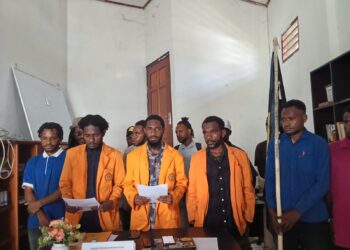
Cypri made the statement online during a discussion session following the public screening and online release of Pig Feast: Colonialism in Our Time, held at the hall of Kristus Terang Dunia Catholic Church in Heram District, Jayapura City, Papua, on Friday (22/5/2026).
“This is a collaborative work, where Dandhy and I are only part of that collaboration,” Cypri Paju Dale said.
He also expressed gratitude to communities in South Papua who welcomed him during the research and production process.
According to him, spending months living alongside Indigenous Papuan communities gave him a deeper understanding of their lives, struggles, and the conditions they face daily.
BERITATERKAIT
“The most important part of this work has been the friends and families in the south who accepted me,” he said.
Cypri emphasized the importance of collaboration in addressing humanitarian issues. He said struggles cannot be carried out individually, but must be built through collective solidarity.
“We know that the strength that comes from the people is a great force. But if it is done separately, it is not resistance,” he said.
According to him, the film was created not only to deliver social and political criticism, but also to reveal the humanitarian realities experienced by Indigenous Papuans.
He compared the situation to major tragedies in world history, including colonialism and systematic oppression.
“The situation happening today is a humanitarian tragedy that deserves broad attention. This film is not merely social criticism or political criticism. This film is a testimony about a humanitarian tragedy,” he said.
Cypri explained that the film portrays how communities struggle not only politically, but also through cultural and spiritual approaches.
Communities seek strength from their ancestors and from God while facing difficult circumstances.
Therefore, he said, the struggle against colonialism and oppression cannot rely on a single approach. Social, cultural, political, and religious elements must unite in confronting humanitarian issues.
He hopes the film can become a space for reflection while also building broader solidarity around the humanitarian issues taking place in Papua.
One of the film’s speakers, Vincent Kwipalo of the Yei Tribe, voiced concerns over the impact of corporate presence in his customary territory.
He said the arrival of companies has affected the daily lives of Indigenous communities in South Papua.
According to the Kwipalo clan leader from Blandin Kakayo Village, Jagebob District, Merauke Regency, South Papua, the film raises many issues so that the wider public can better understand the realities currently faced by Indigenous communities in South Papua.
“If things like this are not written down, filmed, and shared, then people will never know the reality being experienced by Indigenous communities,” Vincent Kwipalo said.
He said many of the problems in his customary territory involve large corporations, security forces, and certain political interests, while Indigenous communities become the most affected parties.
“The community is often the victims. Some are arrested, some are pressured, while the companies continue operating according to their own interests,” he said.
According to him, companies enter Indigenous territories by approaching influential figures with vested interests, a tactic that ultimately triggers division and conflict within communities.
“I witnessed myself how companies enter and exploit communities. They approach certain figures, divide communities, and create tensions,” he said.
Kwipalo stressed that Indigenous communities should not be divided by outside interests, because conflicts among communities only benefit corporations.
He hopes the issues faced by the Yei Indigenous people will be understood not merely as investment issues, but as part of the struggle of indigenous people to defend their livelihoods, living spaces, and rights.
“We are family and we live side by side. If communities continue to be pitted against one another, then the companies are the ones who benefit,” Vincent Kwipalo said. (*)












Discussion about this post