





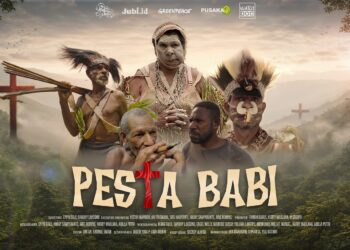
Manokwari, West Papua — Member of Indonesia’s Regional Representative Council (DPD RI) for West Papua, Filep Wamafma, said the documentary film Pesta Babi serves as an important educational medium to open public discussion about the various issues currently faced by people in Papua.
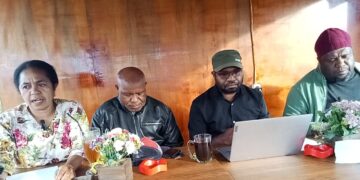
Filep Wamafma made the remarks after attending a public screening of the documentary at the School of Law (STIH) campus in Wosi, Manokwari Regency, West Papua, on Monday (18 May 2026).
The screening was organized by the academic community from Manokwari School of Law in collaboration with academics from Universitas Papua. Participants included students, lecturers, activists, and members of the public.
According to Wamafma, social conflicts arising from competition over natural resources and economic interests occur not only in Papua but also in many parts of the world. However, he stressed that Papua’s problems have unique characteristics requiring serious attention.
“This is a real global phenomenon, but each region has different problems. This film provides a concrete picture of the issues currently faced by Papuan society,” Wamafma said.
He encouraged students, especially law students, to approach the issues raised in the documentary through academic and constitutional perspectives.
Students, he said, should develop systematic analytical thinking by examining facts, legal norms, conducting analysis, and drawing conclusions.
“If there are policies considered harmful to the people or contrary to the Constitution and the Special Autonomy Law, use the state’s formal mechanisms. File cases to the Constitutional Court and pursue judicial reviews. Those constitutional avenues are available,” he said.

Wamafma, who also chairs STIH Manokwari, rejected claims that screenings of documentaries such as Pesta Babi were prohibited by the government.
He said that during a meeting with officials from the Coordinating Ministry for Political, Legal and Security Affairs on 13 May 2026, there was no ban on screening the film.
“The central government has never prohibited this film from being shown. This is part of public education. We can discuss, debate, and express opinions. Those being criticized also have the right to respond. That is the principle of checks and balances,” he said.
Wamafma also highlighted conditions in Papua after Indonesia’s reform era, saying the region had not experienced significant improvement. Instead, conflicts had continued to grow, including alleged human rights violations, social conflict, and disputes involving indigenous communities and investors.
“We once believed that after reform Papua would undergo major positive changes. But in reality, the problems continue to increase and the impacts are felt directly by the people,” he said.
Regarding investment, Wamafma stated that regional development requires both domestic and foreign investment. However, he emphasized that investment must comply with the Constitution and respect the existence and rights of indigenous communities.
He criticized practices that allegedly disregard indigenous rights, including intimidation and inadequate compensation for customary land use.
“If indigenous communities are forced to relinquish land for inhumane compensation, then there is a violation of the Constitution and the Papua Special Autonomy Law,” he said.
Wamafma also raised concerns over internal fragmentation within Papuan society, which he said is often exploited by certain groups to weaken indigenous solidarity.
According to him, differing positions within communities are frequently used to undermine collective efforts to defend rights over land and natural resources.
He urged Papuans to continue pursuing justice through democratic and lawful means.
“I am optimistic that the more people watch this film, the more people will be moved and think critically. Write opinions, build social movements, and voice aspirations through the available legal and political channels,” Wamafma said.
Meanwhile, Victor Rumere, an academic from Universitas Papua, criticized the limited involvement of indigenous communities in investment processes in forest areas.
He argued that various state policies, including large-scale regulations such as the Omnibus Law, had narrowed indigenous communities’ ability to defend their territorial rights.
Speaking after the film screening, Rumere said regulations reducing regional authority had directly affected protections for indigenous peoples, particularly those dependent on forests.
“For indigenous communities, forests are not merely territory. They are identity, natural pharmacies, and food sources. When they are sick, they seek medicine in the forest. When facing food shortages, the forest becomes their source of life,” he said.
Rumere argued that investment projects in indigenous territories are often framed as development and economic growth, while local communities are not fully involved in decision-making.
“We do need investment to encourage economic growth, but there must be proper communication. There are communities living in those areas who have rights over their living spaces,” he said.
He stressed that globally there is already consensus on the importance of involving indigenous peoples before investments are carried out in their territories.
Investors and outside parties, he said, should openly explain the purpose, benefits, and impacts of projects.
“When communities are not given enough information, they do not know what benefits they will receive. In some cases, when they question incoming investments, they instead face pressure,” he said.
Rumere said indigenous communities require support and advocacy to better understand their rights over land and forests.
“At a minimum, communities must know what investments are entering, who the actors are, and what the impacts and benefits will be. That way they can determine whether the investment is worth accepting,” he said.
He expressed hope that the Pesta Babi documentary would raise public awareness about the importance of protecting indigenous peoples.
“If communities have sufficient information, they will have bargaining power to negotiate and defend their rights before they are exploited by outside parties,” Rumere said.
Another academic from Universitas Papua, Sepus Fatem, highlighted what he described as serious threats facing Papua, including ecological destruction, agrarian conflicts, land grabbing, and the involvement of security forces in large-scale food estate projects.
Fatem argued that major investments entering Papua were facilitated by the weakened position of indigenous peoples caused by fragmentation among customary institutions.
“Many indigenous institutions have emerged, but decision-making no longer lies with institutions truly recognized by the people. This weakens our internal position because friction occurs,” he said.
In the context of Indonesia’s National Strategic Projects (PSN), Fatem said the government was relying on legal frameworks such as the Job Creation Law, also known as the Omnibus Law, to accelerate investment while overlooking key principles.
He identified three major concerns: exemptions from environmental permits such as AMDAL and UKL-UPL assessments; projects allegedly inconsistent with spatial planning regulations; and the neglect of the principle of Free, Prior and Informed Consent (FPIC) for indigenous communities.
“There is no consultation between indigenous communities, corporations, or the state. They simply enter, heavy equipment begins operating, and then there is seizure of living space and violence,” he said.
Fatem argued this contradicted the spirit of Papua’s Special Autonomy Law, which should function as a special legal framework for development policies in Papua.
“Central government regulations should adapt to Papua’s Special Autonomy framework, not the other way around,” he said.
As a solution, Fatem urged indigenous communities to map and formally register their customary territories through clan- and community-level deliberations.
According to him, this is important so the state clearly recognizes both the legal subjects and legal objects of customary land, preventing arbitrary takeover.
He also pointed to areas such as Merauke and South Sorong, where communities were already being affected by the arrival of large-scale heavy equipment.
Referring to the documentary, Fatem described land-clearing projects in South Papua as a serious ecological threat.
“This film reminds us that we need a collective struggle to protect and care for Papua. Today, Papua is not in a good condition,” he said.
Fatem stressed that Papua’s future must be built upon four principles: recognition, welfare, justice, and affirmative action.
He called on all sectors of society — academics, students, communities, and government — to build constructive dialogue for Papua’s future.
“Too many Papuans have died on this land. There must not be more victims. The solution is dialogue,” Fatem said.
The public screening of Pesta Babi at the STIH Manokwari campus concluded peacefully and was followed by a public discussion session. (*)









Discussion about this post