




Jayapura, Jubi – The Indonesian government’s plan under President Prabowo Subianto to establish a state-owned export enterprise (BUMN Khusus Ekspor) has sparked sharp criticism from civil society groups. The proposed policy is seen as potentially fueling excessive state dominance in the economy, distorting market competition, and reviving memories of monopolistic commodity practices from the New Order era.
The proposal was introduced by President Prabowo during a plenary cabinet session on Wednesday, May 20, 2026. He said the Export SOE would strengthen Indonesia’s position in global trade, curb tax leakages, and increase the added value of national commodities. Under the scheme, all strategic commodity exports would be required to pass through a single state-owned export entity, which would also be integrated with the country’s sovereign investment management agency, Danantara.
However, critics argue that consolidating state control over business from upstream to downstream comes at the wrong time, particularly as Indonesia’s economic fundamentals are under mounting pressure.
Economist Nailul Huda from the Center for Economic and Law Studies (CELIOS) pointed to several weakening macroeconomic indicators, including the rupiah briefly falling to Rp17,800 against the US dollar and the decline of the Jakarta Composite Index (IHSG).
“This new idea of creating a special export SOE raises concerns over market distortion and the politicization of business,” Huda said during an online press conference on Thursday, May 21, 2026.
Huda described the proposal as a clear manifestation of excessive state capitalism.
“This is a form of state capitalism. The state is no longer acting merely as a regulator, but also as an operator,” he said.
Criticism has also focused on the possibility of repeating the failures of the New Order-era Clove Marketing and Buffer Agency (BPPC), which dominated Indonesia’s clove trade from the early 1990s and 1998. At the time, BPPC acted as the sole buyer and seller of cloves nationwide, effectively trapping farmers who were prohibited from selling their harvests elsewhere.

When cigarette manufacturers reduced production because they could not afford BPPC’s high prices, warehouses overflowed, absorption stalled, and farm-gate prices collapsed.
Huda warned against replicating that experience through the proposed Export SOE. If market monopolies return, he said, smallholder farmers and independent businesses would bear the greatest losses.
Echoing Huda’s concerns, Bustar Maitar, CEO of EcoNusa, stressed the importance of clean and non-partisan governance should the government proceed with the initiative. According to Bustar, Indonesia’s weakening macroeconomic conditions already reflect declining public trust in government policies.
“If this Export SOE is to move forward, it must be managed transparently, free from political interests, and not designed to benefit only certain groups,” Bustar said.
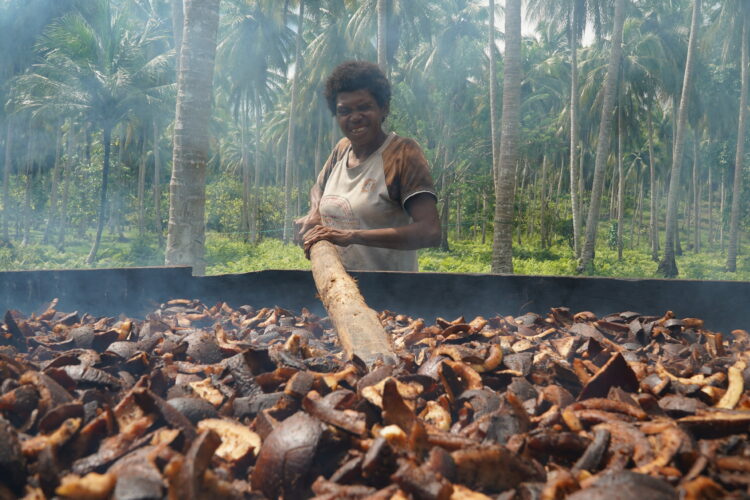
He also urged the government not to sacrifice small-scale farmers, particularly in Eastern Indonesia, where livelihoods depend heavily on plantation commodities. Bustar highlighted the imbalance between people’s commodities such as coconuts, cloves, and nutmeg — cultivated on relatively small plots — and large-scale corporate sectors like palm oil plantations and mining.
“Mining companies may suffer losses, but not to the extent experienced by independent smallholders,” Bustar said, warning of the unequal impacts of export policies.

Meanwhile, Ahmad Ashov Birry, Program Director of Trend Asia, argued that the government was moving too hastily toward establishing a single export gateway while fundamental transparency issues remain unresolved.
Indonesia, he noted, still ranks poorly on the Financial Secrecy Index and continues to face problems related to disclosure of strategic financial information, beneficial ownership transparency, and restricted access to land concession (HGU) data.
At the grassroots level, large-scale corporate economic activities frequently leave environmental burdens on local communities. Ashov cited mining regions plagued by water pollution, soil degradation, loss of productive land, and worsening public health conditions.
“There are still many fundamental problems the government must address before shifting focus to an Export SOE that will dominate export channels,” Ashov said.
He also criticized how the principle of natural resource efficiency has not been directed toward broader public interests, such as public transportation, but remains focused on narrower consumption patterns like private vehicles. Combined with the state’s growing fiscal pressures and easier access to financing, he warned that overexploitation of natural resources could further accelerate environmental destruction.
Warnings of Corruption and Democratic Backsliding
The situation is further aggravated by Indonesia’s declining Corruption Perceptions Index (CPI) between 2009 and 2025. Huda warned that a super-powered institution like the proposed Export SOE would be highly vulnerable to corruption and business politicization due to weak legal systems, poor governance, and shrinking civic freedoms.
These concerns are reinforced by 2025 data from Indonesia’s Central Statistics Agency (BPS), which recorded a troubling trend: Indonesians are becoming increasingly permissive toward corrupt practices in economic activities.
“From securing jobs through insider connections to corruption in public procurement,” Huda explained.
Civil society groups concluded that these developments reflect a serious erosion of democratic values and good governance. Without substantial corrections, they warned, the ambition to establish an Export SOE could ultimately undermine public trust, damage the investment climate, and deepen economic inequality across the country. (*)















Discussion about this post