




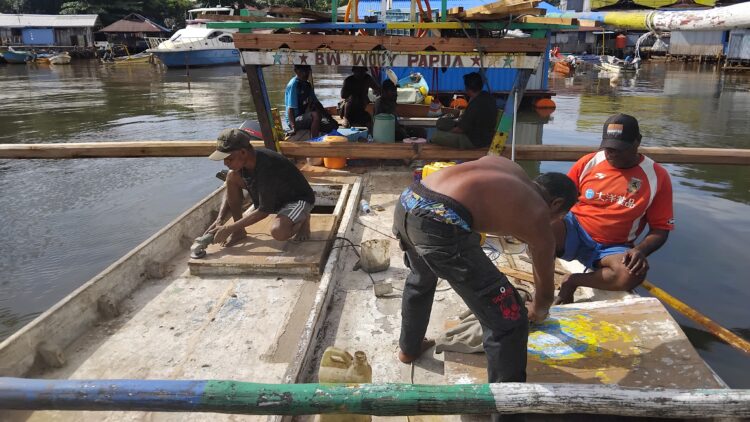
Jayapura, Jubi – Dok 9 Pier in North Jayapura District, Jayapura City, Papua, remains crowded with fishing activity. Boats line the dock as fishermen repair vessels and fishing equipment. But since late last year, many local fishermen have grown increasingly anxious as fish catches decline and their fishing grounds face disruption from the Northern Papua oil and gas block project.
Yonas Lawan, a member of the Karya Fishermen Group in Inpres Dok 9, said the future of local fishermen is under threat.
Beyond increasingly unpredictable weather, the group’s fish aggregating devices, locally known as rumpon, which serve as the primary source of their catches, have allegedly been forcibly cut by survey vessels operated by PT Huatong Service Indonesia (HSI).
The company is conducting seismic surveys to map oil and gas potential for the Northern Papua Oil and Gas Block project.
A single rumpon can cost between Rp50 million and Rp100 million (US$3,000–6,000). Each fishermen’s group, typically consisting of at least 10 people, usually owns two rumpon installed at varying distances offshore.
“We were shocked. We felt they had disturbed our source of livelihood,” Yonas Lawan said on Tuesday (April 14, 2026).
For coastal fishermen, rumpon are the lifeline of communities along the northern and southern coasts of Jayapura. Fishermen rely on them to catch tuna, skipjack, tongkol, and other fish to support their daily needs.
Yonas said his fishing income had enabled him to send all six of his children to school, including one who has graduated from university and secured employment.

“The lives of fishermen depend on the rumpon. We were never informed. The fishermen’s rumpon were cut and taken ashore,” he said.
He said he did not know what work he could do if their fishing grounds and rumpon disappeared.
Kosmos Kendi, a fisherman from the BW Woi Fishermen Group, expressed similar concerns. For the past two months, he said he had stopped going to sea following the destruction of the rumpon.
“The rumpon are our kitchen. They have disrupted our kitchen,” he said.
Coastal communities in Papua generally build rumpon collectively to make fishing easier. Without them, fishing costs increase significantly and the risks at sea become greater. Fishermen typically require around 30 liters of fuel for a round trip. With rumpon, they can fish nearby before returning to shore with their catch.
“The rumpon are like fish houses. Without them, we have to travel farther out to sea, which can risk our lives,” said Semba Rosumbere, a fisherman from North Jayapura.
Traditionally, rumpon are built using discarded iron missile casings washed ashore from Papua New Guinea or the Philippines, tied together with ropes and coconut leaves to create breeding and gathering sites for fish.
Between December 2025 and March 2026, geological survey teams from the Ministry of Energy and Mineral Resources, working through HSI, reportedly cut 58 rumpon points unilaterally to clear paths for seismic surveys related to the Northern Papua Oil and Gas Block project. The area is one of 10 oil and gas working areas identified in Indonesia.
The region was officially included among 10 new potential oil and gas blocks opened by the Ministry of Energy and Mineral Resources on March 4, 2026. However, the Northern Papua block itself is not entirely new. It first emerged in 2009 when the government designated Sarmi Papua Asia Oil Ltd. as the winning bidder for the Northern Papua working area through Director General of Oil and Gas Decree No. 8012/13/DJM.E/2009 issued on April 29, 2009.
Since then, little had been publicly heard about the project until seismic survey activities resumed in 2026. According to technical documents for the Jayapura Block study, the working area covers approximately 7,328 square kilometers across Sarmi and Yalimo Regencies. The survey area stretches even farther, covering Jayapura City, Jayapura Regency, Sarmi, Mamberamo, and Supiori.
For generations, these waters have served as the “dinner plate” of coastal communities in North and South Jayapura Districts. Most fishermen use small wooden boats with outboard engines. Those with rumpon can fish up to 20–30 nautical miles offshore, while fishermen without them generally operate within 5–10 nautical miles. Fishing income supports household needs, with surplus catches sold for savings.
Rumpon Cut Without Public Consultation

The cutting of the rumpon occurred between December 2025 and February 2026. During that period, unstable weather and high waves kept many fishermen from going to sea, delaying their discovery of the damage.
According to data from the Papua Energy and Mineral Resources Agency, 58 fishermen’s rumpon in Jayapura had to be removed because they were located along the seismic survey route.
Kosmos, Yonas, and Semba all said they had never been informed by either the company or the government about the removal of their rumpon. They only realized the devices were gone after returning to sea.
“There were no fish, no place to fish. We returned empty-handed,” Kosmos said.
The HSI survey covers approximately 2,065 kilometers from Jayapura City through Jayapura Regency, Sarmi, Mamberamo, and Supiori Regency.
Asbani Wiyawari, coordinator of the BW Woi Fishermen Group, said around 4,200 families in Jayapura City depend on fishing for their livelihoods. Of those, more than 150 fishermen, representing around 10 fishing groups, have been directly affected by the removal of rumpon.
The fishermen are among the primary suppliers of fresh fish to Jayapura markets and rely heavily on the rumpon for their daily catches.
Semba criticized the absence of public consultation regarding both the survey and the oil and gas project itself.
“They secretly cut the rumpon, and only afterward did we learn about the oil and gas plans,” he said.
The unilateral removals triggered protests from hundreds of fishermen who gathered at the Papua Marine and Fisheries Agency office on Monday (March 16, 2026), demanding compensation.
During the protest, several fishermen threw objects at the agency’s office, breaking several windows.
One of the protest coordinators from Hamadi, South Jayapura, Asbani Wiyawari, said the removal process had not involved proper coordination with rumpon owners.
“If companies want to conduct surveys, they must coordinate with ordinary people first. This situation is not the fault of the community, but the government’s,” he said.
Opposition to the Oil and Gas Block Plan
Fishermen say the removal of rumpon threatens not only their livelihoods but also Jayapura’s food sovereignty. Coastal fishermen remain key suppliers of fresh fish such as skipjack, tongkol, and tuna.
“Since March, fish production has dropped drastically. This has hit household economies and market traders hard. The rumpon are our main source of income. Without them, we struggle to pay for our children’s education,” Semba Rosumbre said.
Asbani added that northern coastal communities in Jayapura have always depended on the sea.
“Even before oil and gas operations begin, the rumpon have already been destroyed. There are no catches now. If operations start, we will have nothing left to eat,” he said.
Kosmos Kendi described the sea as the “garden” of coastal communities. He warned that oil and gas drilling would have long-term consequences affecting future generations.
“We live from the sea. That is why we reject this oil and gas company. Fishermen can no longer go to sea because their kitchens have been destroyed. Oil and gas operations could also pollute the ocean with industrial waste,” he said.
He expressed fears that the environmental impacts could resemble the damage associated with the operations of PT Freeport Indonesia.
Iman Djuniawal, head of the Papua Marine and Fisheries Agency, also criticized the removal of the rumpon, noting that they are vital to the livelihoods of local communities and the food supply of Jayapura City. Around 80 percent of traditional fishermen rely on rumpon.
“Here, the rumpon are the source of livelihood. Our fishermen’s dependence on fishing revolves around them. They are the most vital component and should have been carefully considered,” he said.
He stressed the importance of involving communities in decision-making processes.
“On one hand, we need regional fiscal revenue and additional sources of income. But we must also ensure that this does not damage existing sources of livelihood,” he said at his office on Wednesday (April 15, 2026).
Tommy Yehezkiel Sinaga, spokesperson for HSI as the implementing company for the North Papua 2D Geological Survey, claimed the company had already conducted outreach to fishermen. He said compensation for removed rumpon had been paid in March.
He argued that concerns over marine pollution from future oil and gas development were premature, saying the project remains in the early exploration stage.
“Even if offshore drilling eventually occurs, it will not pollute the environment because current technology is already advanced. In the past there were blowouts and leaks, but now safety systems and maintenance are much better,” he said.
Tommy insisted marine pollution would not occur and claimed fishermen would still be able to fish.
Nathan Baransano, a marine science academic at Universitas Cendrawasih, said both fisheries and oil and gas resources in Jayapura’s coastal waters hold enormous potential. However, he warned the project could bring severe environmental and social impacts, ranging from marine pollution to the loss of fishermen’s livelihoods.
“Fishermen will inevitably lose access to their livelihoods because once oil and gas facilities are built, there will be restricted zones that communities cannot freely access,” Nathan said.
He argued that compensation payments provided by companies and the government would only offer temporary relief.
“These communities do not live for just one or two years. Their children still need education, but their kitchens are being destroyed,” he said.
In the long term, he warned, chronic oil spills and infrastructure development could damage Papua’s northern coastal ecosystems.
“This will disrupt marine coastal ecosystems. Pipelines and anchors will damage habitats, and fish populations will move farther away,” he said.
He added that damage to coastal ecosystems would affect mangroves, seagrass beds, coral reefs, and biodiversity, including leatherback turtle populations in Skow.
“Marine ecosystem recovery alone could take decades compared to the short time needed to destroy it,” he said.
Nathan urged comprehensive planning that considers environmental, social, and cultural dimensions. He outlined several priorities: protecting affected fishermen, conducting marine resource mapping involving local communities, and ensuring strict oversight and sanctions if the industry proceeds.
“The key point is involving communities not merely as those affected, but as decision-makers in the project,” he said.
“Is the Government Sacrificing Papua’s Seas?”
Ronald Wanggai, head of the Oil and Gas Division at the Papua Energy and Mineral Resources Agency, argued that oil and gas exploration causes far less environmental damage than mining activities.
“Mining opens land, clears forests, and pollutes rivers and the environment on a wide scale. Oil and gas investment is more localized, involving drilling at a single point rather than clearing large areas,” he said.
Wanggai said oil and gas potential exists across Sarmi, Mamberamo Raya, Yapen, Waropen, Biak, and Supiori.
“There are around six oil and gas working areas. The survey conducted by the Geological Survey Center covered approximately 2,061 kilometers of seismic routes from the waters of Supiori to Jayapura City,” he said.
Following the preliminary surveys, the central government will determine the official oil and gas working areas before opening them for bidding and exploration.
“This is still in the exploration stage, not production. Studies are still being conducted to determine the scale of reserves and potential resources,” he said. (*)
This article was first published on mongabay.co.id










Discussion about this post