






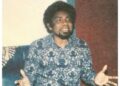
Jayapura, Jubi – The body of Arnold Clemens Ap, a prominent advocate of Melanesian cultural identity in West Papua, was found on Pasir Enam Beach in Jayapura on April 26, 1984.
He was discovered dead from gunshot wounds, allegedly inflicted by Indonesian elite forces known at the time as Kopassandha. His body was found alongside that of his cousin, Edu Mofu. More than four decades later, his death continues to be commemorated.
Arnold Clemens Ap was born on July 1, 1945, in Ampombukor Village, Biak. His cousin Edu Mofu also hailed from the same village in West Biak.
Ap began his education at a primary school in Numfor before continuing to Primaire Middlebare School (PMS) in Biak, a junior secondary-level institution during the Dutch colonial period.
During his time at PMS, he studied alongside several prominent Papuan figures, including Sam Kapisa, JR Mansoben, Frans Wospakrik, Agus Rumansara, HE Mackbon, and SP Morin. Among his juniors were Michael Menufandu, Abraham Atururi, and Piet Wospakrik.
After completing his studies at PMS, most of his peers continued to YPK High School in Ridge, Biak, while others pursued education in Jayapura.
Ap later enrolled at the Faculty of Teacher Training and Education (FIK), majoring in Geography, where he earned a diploma-level qualification. In 1974, he joined a research expedition to Asmat alongside JR Mansoben under the guidance of Prof. Dr. Walker.
While Mansoben later pursued anthropology studies at the University of Indonesia, Ap continued his studies in museum curation at University of Melbourne.

Upon returning from Australia, Ap settled in Jayapura and began working at the museum of Cenderawasih University. Under his influence, the university museum evolved into a center for cultural preservation and artistic activity in Papua.
While working as a curator and later establishing the Mambesak group, Arnold Clemens Ap had earlier formed the Manyori Group to perform in the Pelangi Budaya (Cultural Rainbow) program on Republic Indonesia’s Radio (RRI).
At the time, weekly cultural activities were also held at the courtyard of the Cenderawasih University Museum in Abepura. These events featured traditional dance, vocal group performances, and mob (Papuan choral singing), involving local artists as well as high school students.
These cultural activities were largely driven by the emergence of the Mambesak, a Papuan folk music group founded on August 5, 1978, at Cenderawasih University.
“I typed the invitation letters and delivered them to all members. Everyone agreed on the name Mambesak, and Brother Arnold was appointed as its leader,” said Th. Wolas Krenak.
Among those present at the group’s formation were Eddy Mofu, Sam Kapisa, Yoel Kafiar, Martiny Sawaki, Abner Korwa, Yohana Yembise, Uslin Monim, and others.
Shortly after its establishment, Mambesak began producing songs in local Papuan languages, recording them independently on cassette tapes despite limited technology. Costan Ruhukail served as the group’s recording technician, producing up to six albums featuring songs from various ethnic groups across Papua.
Arnold Clemens Ap placed strong emphasis on authenticity. He ensured accurate pronunciation in each local language and insisted that traditional instruments such as the tifa (West Papuan traditional drum) be played according to the distinct styles of each ethnic group, including the well-known rhythms and dances of the Asmat people.
Krenak recalled performing with Mambesak at a national cultural event in Jakarta, where he played the tifaand learned the diverse drumming techniques—known as toki tifa—from different Papuan traditions.
Mambesak’s songs were also broadcast through radio programs such as Pelangi Budaya and Pancaran Sastra on Radio Republik Indonesia (RRI) Nusantara V Jayapura, aired every Sunday afternoon. Members of the group often served as broadcasters, introducing Papuan culture through music, dance, and storytelling.
However, Mambesak’s final performance took place on November 29, 1983, at the Governor’s Office of then Irian Jaya Province.
Soon after, Arnold Ap, Edu Mofu, and two others were arrested and detained.
Three months later, the bodies of the two Papuan artists and cultural figures were found floating at Pasir Enam Beach on April 26, 1984. (*)








Discussion about this post