




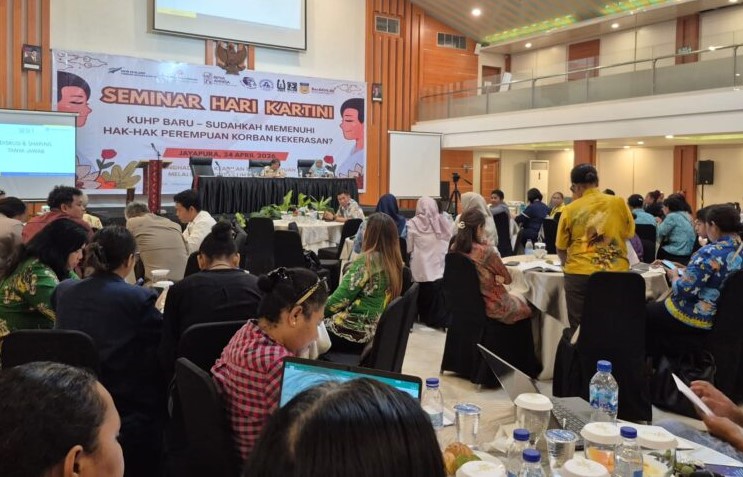
Jayapura, Jubi – The rights of women and children who are victims of violence were the focus of a seminar titled “The New Criminal Code: Does It Fulfill the Rights of Women Victims of Violence?” held on Friday (April 24, 2026).
The seminar was organized by Rifka Annisa in Sentani, Jayapura Regency, Papua, bringing together a range of stakeholders, including local government officials, law enforcement authorities, service providers, and civil society organizations.
The event formed part of the commemoration of Kartini Day on April 21, and aimed to strengthen protection networks for women and children across Papua Province.
The panel discussion was held following the enactment of Law No. 1 of 2023 on the Criminal Code (KUHP), which came into force on January 2, 2026.
The new Criminal Code emphasizes corrective, rehabilitative, and restorative justice approaches, prioritizing conflict resolution, restoration of balance, and offender rehabilitation.
However, participants noted that its implementation still raises a number of concerns, particularly regarding protections for women and child victims of violence.
Organizers argued that the sanctions outlined in the new code may not fully accommodate the best interests of victims, including what they see as relatively lenient penalties for perpetrators.
Indiah Wahyu Andari, Director of Rifka Annisa, said the seminar aimed to improve understanding of the implementation of the new Criminal Code (KUHP), particularly in ensuring the rights of women and child victims of violence.
“Proper understanding and implementation are essential, especially for law enforcement officers and service providers,” she said during the seminar.
Indiah Wahyu Andari also raised concerns that the new Criminal Code (KUHP) could potentially sideline several specialized laws, including those on domestic violence, child protection, sexual violence, and human trafficking.
She noted that Papua presents unique challenges, both geographically and in terms of limited human resources, which can affect access to services and the handling of cases involving violence against women and children.
Program coordinator at Rifka Annisa, Anita Ernauli Mabun, said the seminar was informed by the experiences of civil society organizations in Papua, which often face difficulties when handling such cases.
“Many service providers, including The Alliance for Democracy in Papua (ALDP), The Institute for Women’s Empowerment and Child Protection in Papua (LP3AP), and The Legal Aid Institute of the Indonesian Women’s Association for Justice (LBH APIK), have struggled to map the elements of criminal acts in these cases, even though regulations are already in place,” Mabun said.
Through its BERDAYA Program, she added, Rifka Annisa has worked to strengthen the capacity of civil society organizations in Papua and South Papua, including ALDP and LBH APIK Jayapura.
The five-year program is now entering its final phase. Mabun stressed that civil society groups cannot work in isolation and must maintain coordination with government institutions, particularly service units such as the UPTD for Women and Child Protection.
Academic from the Faculty of Law at Universitas Gadjah Mada, Sri Wiyanti Eddyono, said the new KUHP introduces significant developments in the criminal justice system, particularly in the protection of sexual violence victims.
She highlighted key changes in the legal definition of rape, noting that sexual intercourse with minors under the age of 18 is now explicitly categorized as rape.
“In the past, sexual relations with minors and rape were treated differently. Now, intercourse with a minor is classified as rape, making the argument of consent irrelevant,” she said.
Eddyono added that the definition of rape is no longer limited to penile-vaginal intercourse, but includes various forms of penetration, including within marriage.
The concept of violence has also been broadened, no longer confined to physical force but encompassing threats, power relations, and situations of vulnerability that prevent victims from giving free consent.
She further noted that the new KUHP strengthens victims’ rights in criminal proceedings, including access to legal assistance, protection during investigation and prosecution, and the right to restitution.
“Investigators are required to assess victims, must not blame them, and examinations must take into account the victim’s trauma,” she said.
Victims can also provide testimony through video recordings, which may be used as evidence in court. Courts are required to ensure that victims’ voices are heard, including through remote testimony where necessary.
However, Eddyono pointed to ongoing challenges, including limited access to psychological services—despite their importance, as psychological assessments can serve as legal evidence.
She also highlighted inconsistent interpretations of legal provisions among law enforcement officials and a lack of victim-sensitive approaches, as well as weak inter-agency coordination and limited facilities such as safe houses.
In some cases, she added, sexual violence cases are still mediated, despite the inappropriateness of such approaches.
Meanwhile, Head of the Jayapura Regency Office for Women and Child Protection, Beatriks Awaitouw, welcomed the seminar, saying it provided valuable insights for local government officials.
“This activity has enhanced our understanding in carrying out our duties in women and child protection,” she said.
She added that the seminar also serves as a learning space for assessing how far the new KUHP can meet the rights of women and child victims.
Awaitouw noted that the Jayapura Regency Government recently established a Women and Child Protection Task Force (Satgas PPA) to strengthen protection efforts at the community level.
Data from the regional UPTD-PPA shows that between January and April 2026, six cases of violence against women were reported and handled, mostly involving abuse and assault.
She said reports are received not only directly from the public but also through schools, community health centers, task force members, and paralegal teams in the field.
According to Awaitouw, the new KUHP provides clearer procedures for handling cases compared to previous regulations. However, its implementation remains a challenge for local governments, particularly in strengthening service facilities and human resource capacity.
Rico Takai Yama, Assistant Program Officer for the BERDAYA Program at The Asia Foundation, said the seminar was part of program support funded by the New Zealand Government.
The program is implemented in collaboration with local partners, including Aliansi Demokrasi untuk Papua and LBH APIK.
“This is a new legal framework that must be understood collectively to ensure its implementation meets expectations, particularly in addressing the needs of women and child victims of violence,” he said.
According to Rico, the seminar is the first of its kind in Papua to specifically discuss the implementation of the new KUHP in the context of protecting women and children.
He added that there are plans to establish a multi-stakeholder forum in Papua focused on handling cases of violence against women and children, with the aim of strengthening coordination between government institutions, civil society, and law enforcement.
Such a forum, he said, is expected to improve the effectiveness of case handling and ensure a more victim-centered approach. (*)














Discussion about this post