





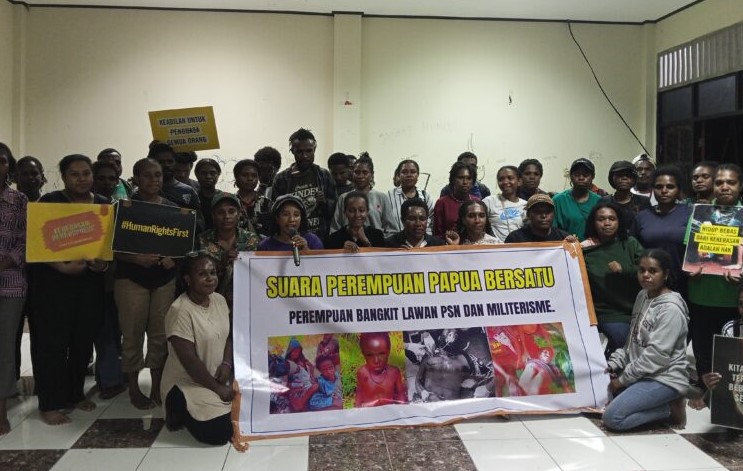
Jayapura, Jubi – Women’s rights activist Vero Hubi says there has been a noticeable shift in how women are perceived in Papua, a change she attributes to the erosion of customary values under external influences.
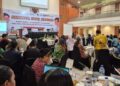
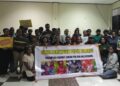
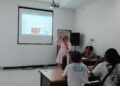
Hubi made the remarks during a public discussion titled “Women Rise Against National Strategic Projects (PSN) and Militarism”, organized by Suara Perempuan Papua Bersatu in Perumnas 3 Waena, Heram District, Jayapura City, on Thursday (April 23, 2026).
She said the changing perspective on women cannot be separated from broader transformations driven by the influence of the state, religion, and capitalism, which have reshaped traditional social structures.
“It is important to understand the realities experienced by Papuan women in recent years, including the increase in various forms of violence,” said Vero Hubi.
According to Hubi, before sustained contact with the outside world, Papuan customary systems had long governed relationships between men and women based on mutual respect and balance. And in the past, elders understood how to position men and women equally, with respect embedded in those relationships.
However, she noted that these values have gradually shifted. Practices such as bride price, which were traditionally understood as a form of respect and appreciation, are increasingly being misinterpreted as granting full ownership over women.
“This has reinforced discriminatory practices and restrictions against women,” she said.
Hubi said that within organizational spaces and political movements, women still face significant limitations, often being seen as unfit to lead or take on strategic roles.

“This is a form of oppression [against women] that is still ongoing. If we are all fighting against oppression, then women should not be restricted. We must move forward together,” she said.
She emphasized the importance of revisiting local values that uphold equality and humanity as a foundation for advancing women’s rights.
Meanwhile, legal advocate Novita Opki described the discussion as an important platform for amplifying women’s narratives within Papua’s political struggle.
She noted that women’s voices have long been marginalized in public discourse.
“This is an important space because it brings women’s perspectives into the political struggle,” Opki said.
According to her, the oppression of Papuan women has persisted since the period of Papua’s integration into Indonesia. Today, armed conflict, military operations, and development projects continue to have profound impacts on women’s lives, often triggering internal displacement.
She said Papuan women are frequently affected by conflict, both directly and indirectly.
“Trauma from violence, loss of homes, and limited access to basic needs remain realities faced by [Papuan women] to this day,” she said.
Opki also highlighted that investment and development projects often overlook the principle of Free, Prior and Informed Consent (FPIC), leading to the dispossession of Indigenous communities’ living spaces.
She added that the involvement of security forces in supporting such projects—through the framework of Military Operations Other Than War (OMSP)—has further entrenched militarization in Papua.
“Let us agree that the struggle of Papuan women is not only about resisting violence, but also about defending identity, living space, and fundamental rights,” she said.
The discussion is expected to serve as a starting point for broader dialogue and to strengthen solidarity in the fight for justice for Papuan women. (*)











Discussion about this post