




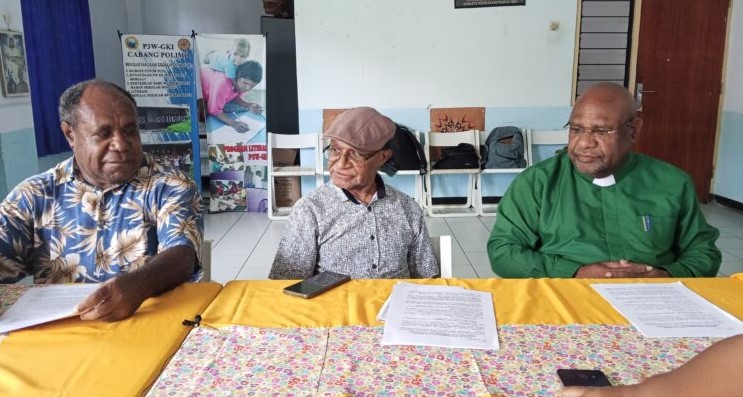
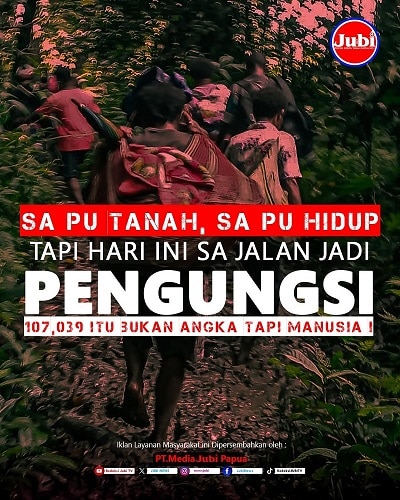
Jayapura, Indonesia, April 21 (Jubi) — The Papua Church Council said about 107,000 people have been internally displaced across Papua as of April 2026, driven by escalating violence and a worsening humanitarian crisis since late 2018.
The council said the situation has intensified in recent months, particularly between March and April, in highland areas such as Puncak and Dogiyai regencies.
Reverend Dorman Wanimbo said increased military operations have directly affected civilians, triggering mass displacement and disrupting access to basic services.
“In addition to causing casualties, the situation has disrupted education, economic activity and worship, while access to healthcare remains крайне limited,” he said in a statement issued in Jayapura on Tuesday.
He added that displaced communities face shortages of food, healthcare and protection, worsened by the expansion of military activities into civilian areas including villages, churches, schools and markets.
He also added that the recent incidents in Pogama and Kembru districts in Puncak Regency,
Central Papua, reportedly resulted in civilian casualties following military operations conducted between April 12 and 15 involving ground and air forces..
The attacks damaged homes and caused civilian casualties, including deaths and injuries. Casualty figures could not be independently verified. Some reports said nine people were killed and five injured, while others put the toll at 15 dead and seven wounded.
“About seven villages were directly affected, and parts of the area remain difficult to access. Witnesses said the attacks occurred in areas previously considered civilian zones and places of refuge,” he said.
Indigenous pastor John Bunay said the council believes the situation is linked to state policies, including Presidential Instructions No. 9/2017 and No. 9/2020 on accelerating development in Papua and West Papua.
“A development approach combined with a security approach has deepened the humanitarian crisis and further marginalized Indigenous Papuans,” he said.
He cited previous studies by the Indonesian Institute of Sciences identifying the root causes of the conflict as racism, development failures, political tensions and weak accountability of security forces.
“However, a peaceful dialogue approach has yet to become a primary priority,” he said.
The council called for an immediate halt to military operations in civilian areas, greater protection for civilians and unrestricted humanitarian access for displaced communities. It also urged an independent investigation into alleged human rights violations and called for access for foreign journalists to report on Papua.
They also called for the importance of peaceful dialogue as the path to resolving the conflict, urging churches, civil society, and all stakeholders to unite in prayer and concrete action to safeguard the lives of Papuans currently facing a humanitarian crisis.
Because, the future of Papua can only be built on justice, humanity, and dignified peaceful dialogue—not violence. (*)







Discussion about this post