






Sorong, Jubi – Indigenous Papuan women traders in Sorong Regency say high transportation costs, limited access to proper market space, and lack of business capital continue to make it difficult for them to support their families.
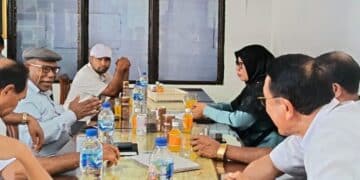
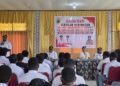
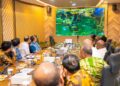
More than 100 women traders, widely known as Mama-Mama Papua, gathered under the Sorong City Papuan Women Traders Association (Perkumpulan Perempuan Mama-Mama Pedagang Kota Sorong) to meet with the Sorong Regency Government in Sorong on Wednesday (8/4/2026). The meeting brought together representatives from various villages, alongside P2MPKS Chair Levina Duwith and facilitator Yohanis Mambrasar.
Opening the discussion, Mambrasar described the difficult conditions faced by Papuan women traders and emphasized their ongoing struggle to access basic economic rights. He also pointed out that Special Autonomy funds have not yet significantly benefited these traders.
Several representatives spoke directly about the challenges they face. Mama Kesya Asrima explained that traders from Slakma, Sayosa, Snook, and Maudus must pay around Rp3 million for transportation just to reach the market, despite earning only Rp200,000 to Rp300,000 per trip. She added that although the government built Mariat Market, its location is not strategic and lacks buyers. “We cannot sell in a market with no customers,” she said.
*****************
Jubi.id adalah media yang berbasis di Tanah Papua. Media ini didirikan dengan sumberdana masyarakat melalui donasi dan crowd funding. Dukung kami melalui donasi anda agar kami bisa tetap melayani kepentingan publik.
*****************
Mama Mince Malibela, representing women traders from Klayili District shared similar concern. She said high transportation costs make it difficult for them to sell their garden produce.
“We ask the government to help provide transportation, as well as business capital. It could also be in the form of a savings and loans cooperative,” she said.
She also urged the government to build markets for Papuan women in strategic locations, so they would not have to travel to the city to sell their produce.
“We, women traders from Klamono, come to sell at Remu Market. We compete for selling space with other traders, and sometimes we even end up fighting among fellow Papuan traders over space.”

“We sell until night and sleep on the market tables. We have to pay for the selling space to non-Papuan traders, shop owners, and even for the electricity we use.”
“Our area, Klamono, is where oil is extracted by PetroChina/Petrogas. We contribute significantly to the regency’s revenue, but there is no transportation provided for us to get to the market, so we have to pay expensive fares for transport vehicles.”
Mama Matseba Yadanfi from Klamono described the difficult situation at Pasar Remu, where traders compete for limited space, sometimes leading to conflict among fellow Papuan traders. She said they often stay overnight at the market, sleeping on tables, while also paying fees to shop owners and for electricity. Despite Klamono’s contribution to regional revenue through oil extraction, traders still lack access to affordable transport.
From Buk District, Mama Dili Momot highlighted the severe burden of transportation costs for inland traders, who must spend between Rp3–4 million for a round trip to the market. With modest earnings from selling bananas and vegetables, their income barely covers expenses and her daughter’s tuition.
Responding to these concerns, Agata F. Tenau, Head of Planning Division at the Regional Development Planning Agency (Bappeda) of Sorong Regency, is planning to coordinate with the Sorong City Government to provide better trading spaces, particularly at Pasar Remu. They also indicated plans to encourage provincial authorities to provide public transportation for traders.
Head of the Trade and Industry Office (Koperindag) of Sorong Regency, Marthen Pajala, said that the Sorong Regency Government has been using Special Autonomy (Otsus) funds to provide business facilities such as tents and containers, which have already been distributed to Papuan traders. He added that proposals for business capital assistance for the women traders can be submitted according to the existing mechanism, with data from members of the Perkumpulan Perempuan Mama-Mama Pedagang Kota Sorong to be included in the 2027 program.
Responding to the statements from the Koperindag Office and the Planning Division, P2MPKS facilitator Yohanis Mambrasar urged the agency to take a more progressive approach in addressing the women traders’ concerns by preparing more concrete programs, so they would not have to wait another year.
“If the Koperindag Office can prepare a business capital assistance program to be included in the upcoming budget revision session, I think that would be very good,” he said.
At the end of the meeting, the P2MPKS chair, representing all Papuan women traders, read out their demands and submitted a formal document to the head of the Koperindag Office. The document called on the government to provide business capital in the form of direct financial assistance as well as cooperative-based savings and loan schemes, to ensure proper and designated selling spaces at Remu Market, to supply basic trading facilities such as stalls, tables, and tents for roadside vendors selling areca nut and cooking oil, and to provide transportation services tailored to traders’ routes in each district.
The meeting was held at the invitation of the Sorong Regency Government in response to a request for a hearing submitted earlier by P2MPKS in January 2026. The organization serves as a platform for indigenous Papuan women traders across Southwest Papua Province. (*)
Iklan Layanan Masyarakat ini Dipersembahkan oleh PT. Media Jubi Papua











Discussion about this post