




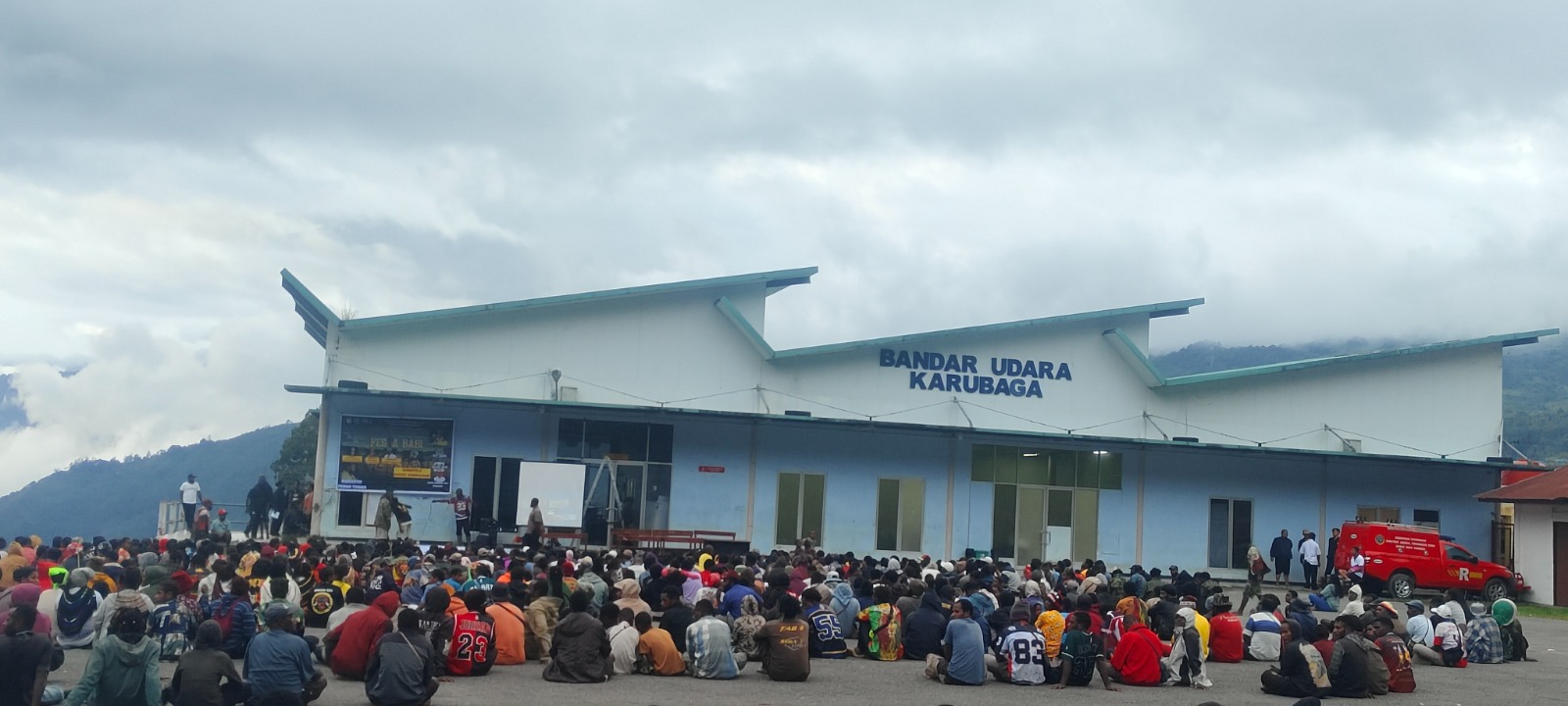
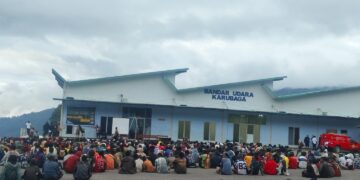
Jayapura, Jubi – Thousands of residents in Tolikara Regency, Papua Highlands, including elders, youth, and children, gathered at Karubaga Airfield on Wednesday to watch the documentary Pig Feast: Colonialism in Our Time and participate in a public discussion following the screening.
The documentary, directed by Dandhy Dwi Laksono and Cypri Dale, was screened by the Tolikara Generation Care Forum.
The film explores a range of topics, including social injustice, the dispossession of Indigenous lands, and limited access to information in Papua.
Although the documentary has often been regarded as a sensitive work, the public screening proceeded peacefully, orderly, and with strong community enthusiasm.
The event also provided a space for young Papuan intellectuals to share critical and academic perspectives on the future of their region.
Jefry Yesaya Wandik, chair of the organizing committee, said the screening was initiated as an educational opportunity for both Papuan and non-Papuan residents living in Tolikara, particularly in Karubaga.
“We want people to learn through this documentary. Pig Feast, produced by Dandhy, Cypri, and their colleagues, carries an important message about protecting the environment and paying attention to the lives of Papuan communities amid the challenges they face today,” Wandik said.
According to Wandik, the event’s theme, Protect Nature, Create the Future, served as the central message of the discussion. He said that unless Papua’s environment is protected today, the future of the next generation will be at risk.

“Papua is a heritage that must be safeguarded collectively. Parents, churches, and youth organizations all have an important role in protecting the rights of Indigenous Papuans to their land and livelihoods,” he said.
Addressing spontaneous chants and emotional reactions from some audience members during the event, Wandik described them as expressions of frustration from people who feel the state has not fully fulfilled its responsibility to protect Papuans and their land.
Nevertheless, he stressed that the event was not intended to provoke the public or undermine national unity.
“On the contrary, this was a shared educational space. Many people from Java, Sulawesi, Kalimantan, and other regions joined us in watching the film. This demonstrates that the issues facing Papua are humanitarian concerns that can be understood by all Indonesians,” he said.
Wandik noted the high level of public participation in the event. Organizers estimated that more than 1,120 people attended, including community members, youth groups, elementary, junior high, and senior high school students, as well as various youth organizations. In addition to the film screening, the committee invited five speakers to help facilitate the discussion.
Meanwhile, Vigor Vigran Yikwa, chair of the Evangelical Church in Indonesia (GIDI) Youth Organization for the Toli Region, expressed gratitude for the successful event. He said the documentary had helped raise awareness about the realities currently facing Papua.
“Before watching this film, many of us viewed the situation in Papua as relatively normal. But after seeing it, we—young people, parents, and children alike—have become more aware that Papua is confronting many serious challenges,” Yikwa said.
He expressed hope that the documentary would encourage younger generations to continue protecting Papua, which he described as the “mother” of Indigenous Papuans.
“We thank Dandhy, Cypri, and everyone involved in producing this documentary. May God bless them,” he said. (*)






Discussion about this post