




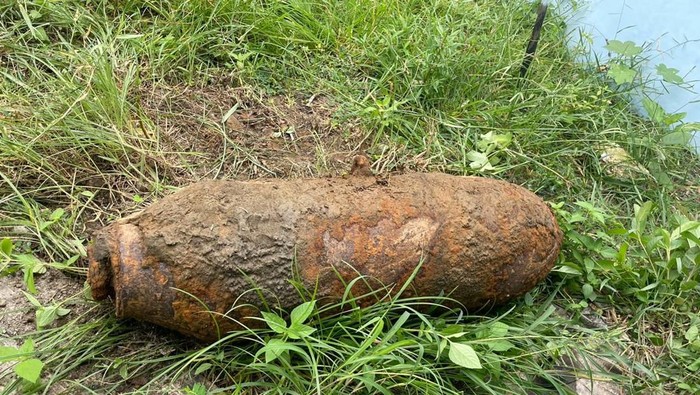
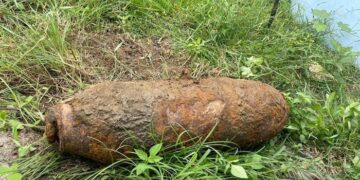
Jayapura, Jubi – Residents of Biak Numfor Regency, Papua, were recently shocked by a deadly explosion that occurred on Sunday, May 31, at around 2:45 p.m. local time. The blast was caused by what authorities believe was an unexploded bomb dating back to World War II.
CCTV footage from Biak Seaport captured flames, thick smoke, and a powerful explosion that rocked the area that afternoon.
The suspected wartime bomb exploded in the Fisheries Complex on Wolter Monginsidi Street, Fandoi Subdistrict, Biak Kota District, Papua Province.
The incident killed six people and injured 19 others, who were taken to hospital, damaged at least 10 homes, displaced 55 families, and drew international media attention, including coverage by the French news agency Agence France-Presse (AFP).
The explosion reportedly occurred when residents attempted to cut open the device to extract gunpowder, allegedly intended for use in illegal blast fishing operations.
Friction from a saw generated heat that ignited the explosive material, triggering a massive blast. At least 10 homes were damaged, several of them completely destroyed.
Older residents recalled that during the 1980s, fishermen in Papua—particularly in Biak and Jayapura—were believed to have used World War II-era explosives to catch fish in the waters of Humboldt Bay (Yos Sudarso Bay) and around Biak Numfor.
“Yes, that’s true. Back then, many people searched for old bombs. The late Police Colonel Amandus Mansnembra used to say that experts in the United States spent years learning how to manufacture bombs and handled them with extreme caution, while here in Papua people could dismantle Japanese and American World War II bombs using nothing more than a saw and a hammer,” Septinus, a resident of Dok V in North Jayapura District, told Jubi on Wednesday (June 3, 2026).

Speaking jokingly, he said local residents had even developed their own methods for dismantling bombs.
“People used to say that Japanese-made bombs had to be turned to the left to open them, while American-made bombs could simply be cut open with a saw,” he said.
Septinus also recalled a major bomb explosion that occurred in Jayapura during the 1980s, when several children from the Bhayangkara housing complex were injured by an explosion near Dok II, across from the Papua Governor’s Office.
According to him, former Persipura goalkeeper Elly Tiba suffered a permanent leg injury in the incident, although he remained able to walk.
At the time, an abandoned amphibious vessel from World War II sat rusting in front of the provincial government office.
“Children from Dok V and Bhayangkara often played and swam around the wrecked ship, which was a remnant of World War II,” he said.
One tragic day, a resident was reportedly sawing open a bomb inside the wreck when it suddenly exploded. Children from the nearby Bhayangkara complex became victims of the blast.
The explosion was considered one of the largest incidents of its kind in Jayapura, leaving many children injured.
Another area, Argapura Beach in South Jayapura District, became known as “Vietnam Village” because residents there were once widely associated with the use of explosives for fishing.
Many fishermen in the area reportedly lost limbs after accidents involving homemade fish bombs, locally known as dopis, which were often assembled using sulfur or explosive powder.
Papuan Paralympic athlete Marinus Melianus Yowei was also seriously injured in a fish-bomb accident. According to local accounts, he was preparing to throw a fish bomb into the sea but failed to release it in time, causing it to explode and injure him and several companions.
Similar fish-bomb explosions have continued to occur in recent years.
In April 2025, a 44-year-old man identified as Agus was killed in Abepura District, Jayapura City, when a fish bomb he was assembling inside his home exploded. The device reportedly used mortar-based explosive material.
Earlier, in March 2017, a resident of Abepantai, Abepura District, named Terry Wamuar, 47, died after a homemade fish bomb he was assembling exploded.
A similar incident also occurred at Base G Beach in North Jayapura District on December 12, 2007, killing Yeremias Wanggai, who was carrying the explosive device at the time.
His son, Manas Wanggai, then 15 years old, suffered severe injuries across much of his body and underwent intensive treatment at Dok II Regional General Hospital in Jayapura. (*)









Discussion about this post