





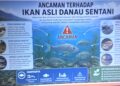
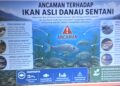
Jayapura, Jubi – The Dean of the Faculty of Mathematics and Natural Sciences (FMIPA) at Cenderawasih University, Dr. Henderite L. Ohee, M.Si., says that of the 35 fish species recorded in Lake Sentani, Jayapura Regency, Papua, more than half are now introduced or exotic species, including senhead fish (Channa striata) and flowerhorn cichlids.
“It is very alarming. Three months ago, fishermen caught a pleco in their nets,” Ohee said during the National Webinar on “Conservation of the Lake Sentani Ecosystem: Preserving Biodiversity Amid Environmental Change from the Perspectives of Academics, Researchers, and Policymakers” on Tuesday (June 2, 2026).
According to Ohee, the discovery is particularly concerning because it poses a serious threat to native fish species in Lake Sentani, including rainbowfish and the endemic Sentani gudgeon.
“Since 2013, I have been compiling fish data and identified 35 species. However, our latest research conducted between 2021 and 2024 found only 22 species remaining, of which more than 50 percent are introduced species,” he said.
Of the 22 species recorded, only nine are native, while 13 are introduced species, including flowerhorn cichlids and snakehead fish.
Ohee explained that one of the main causes of native fish decline is competition for food resources, particularly algae, between invasive species such as flowerhorn cichlids and native fish, including the Sentani gudgeon and the Red Rainbowfish.
“Flowerhorn cichlids reproduce very rapidly because they also feed on the eggs of Sentani rainbowfish,” he said.
Meanwhile, researcher Prof. Gadis Sri Haryani of the National Research and Innovation Agency (BRIN) suggested that the introduction of the pleco (Pterygoplichthys) into Lake Sentani may have resulted from aquarium owners releasing the fish into the wild.

“People may not have realized the consequences and simply released them from their aquariums. Once in the lake, they can spread, grow to a large size, and become a threat to the ecosystem,” Haryani said.
She noted that communities around Lake Sentani have long practiced a traditional conservation system known as burekheng, which helps protect and sustain native fish populations, particularly the Sentani gudgeon.
Burekheng, or sero, is a traditional fish conservation and harvesting method that has been practiced for generations by communities living along the shores of Lake Sentani.
“This local wisdom utilizes barriers or enclosures made from natural materials such as sago fronds and leaves to fence off sections of water where fish can be protected and raised,” she explained.
Haryani said the practice remains a valuable solution for preserving the lake’s ecosystem. However, she emphasized that maintaining water quality is equally critical to safeguarding native fish species.
The Head of the Papua River Basin Agency (BWS Papua), Dave H. I. Muchaimin, reminded regional governments that conservation areas must remain a priority when drafting district and provincial spatial planning policies.
He noted that sedimentation in Lake Sentani has worsened due to disturbances in forested areas and the Cyclops Mountains conservation zone, resulting from land-use changes that contributed to the 2019 natural disaster.
“Conservation areas must not be compromised. Lake Sentani is protected under numerous legal frameworks, including a Special Regional Regulation, and is one of Indonesia’s 15 national priority lakes,” he said.
Muchaimin also pointed to the narrowing of the Jaifuri River channel, which serves as Lake Sentani’s main outlet, attributing it partly to suspected illegal mining activities that have caused sediment buildup.
“I appreciate the Jayapura Regent for visiting the Anafre River area, where illegal mining operations have been using heavy equipment, including excavators,” he said.
The agency has also carried out reforestation efforts by planting eucalyptus trees and conducting clean-up operations to combat water hyacinth infestations in Lake Sentani.
“I agree with Dr. Henny Ohee that protecting the Lake Sentani ecosystem requires collaboration among all stakeholders, including local communities, NGOs, and schoolchildren,” Muchaimin added.
Professor Daniel Lantang warned that native fish species face a real risk of extinction, noting that the endemic Sentani gudgeon (Oxyeleotris heterodon) has become increasingly rare in local markets.
“I visit Sentani Market three times a week, and it is now very difficult to find native Sentani fish, especially the Sentani gudgeon,” he said.
Lake Sentani has already lost one of its most iconic species: the freshwater sawfish, which disappeared from the lake decades ago. The last recorded catch by local fishermen was in 1974.
The species became locally extinct due to overexploitation, environmental degradation, and the widespread use of gill nets.
Ohee further noted that Sentani rainbowfish populations are also declining. Two rainbowfish species found in the lake—the Sentani Rainbowfish and the Red Rainbowfish—are native to the ecosystem, with one being endemic to Lake Sentani.
According to Muchaimin, these rainbowfishes are commonly found at river moths around lake Sentani.
Another notable native species is the Sentani gudgeon (Oxyeleotris heterodon), known locally as kayaou. The fish is highly valued by communities around Lake Sentani and serves as the main ingredient in the traditional nutrient-rich dish Kha Ebhe Hele (Black Broth Sentani gudgeon). (*)


















Discussion about this post