




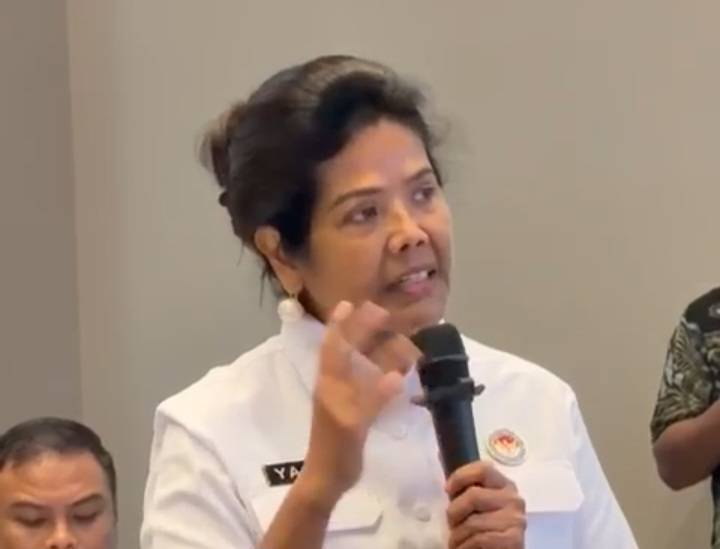
Jayapura, Jubi – Yanni, a member of the Executive Committee for the Acceleration of Papua’s Special Autonomy Development, has proposed that the central government distribute Special Autonomy (Otsus) funds directly to Indigenous Papuans through a cash assistance program.
The chair of the Papua Provincial Regional Leadership Council of the Gerindra Party also proposed increasing the General Allocation Fund (DAU) for the six provinces in Papua.
Yanni said she presented the proposals during a meeting with several stakeholders in Jakarta in May 2026.
According to Yanni, during a meeting with Vice President Gibran Rakabuming Raka in Manokwari, West Papua, in November 2025, the vice president stated that approximately Rp200 trillion in Special Autonomy funds had been allocated to Papua over the past 25 years.
However, Yanni argued that not all of those funds had directly benefited Indigenous Papuans.
“For example, if Special Autonomy funds are used to build roads, those roads are not used exclusively by Indigenous Papuans. We can see how many Indigenous Papuans actually own vehicles, whether cars or motorcycles. The funds are called Special Autonomy funds, but they are also used by non-Indigenous residents,” Yanni said on Thursday.
She made a similar argument regarding the allocation of 30 percent of Special Autonomy funds for education. Since schools serve both Indigenous and non-Indigenous students, she said, programs funded by Special Autonomy funds cannot be restricted solely to Indigenous Papuan children.
“It would be impossible to say that because a program is funded by Special Autonomy funds, only Indigenous Papuan students can benefit from it. The same applies to healthcare. You cannot tell a patient in a hospital that food funded through Special Autonomy funds is only for Indigenous Papuans. That is simply not possible. Although it is called Special Autonomy funding, the Rp200 trillion has not been enjoyed exclusively by Indigenous Papuans,” she said.
For that reason, Yanni suggested that the government consider distributing part of the funds directly to Indigenous Papuans through cash transfers. Under her proposal, Indigenous Papuans aged 17 and above would receive Rp1 million per month.

“If there are five Indigenous Papuans aged 17 and above in one household, they would receive Rp5 million each month. The funds could then be used directly for their needs instead of being channeled through programs whose benefits are not fully enjoyed by Indigenous Papuans,” she said.
Yanni suggested that the proposal could be considered during future revisions to the Special Autonomy Law, with details on eligibility and implementation mechanisms to be further discussed.
She also called for an increase in the General Allocation Fund, noting that the six provinces in Papua currently receive only 2.25 percent of Special Autonomy funds through the DAU mechanism.
According to her, that amount is insufficient to support accelerated development across six provinces.
“How can we talk about accelerating development when the General Allocation Fund derived from Special Autonomy funds is only 2.25 percent and must be shared among six provinces? The resources are extremely limited. That is why I proposed allocating one percent for each province in Papua,” she said.
Yanni said she had learned that Aceh Province was seeking an increase in its DAU allocation to 2.5 percent. She argued that Papua should receive similar consideration from the central government.
“If Aceh can receive 2.5 percent for a single province, then Papua, with six provinces, should receive proportionally more. Papua is far larger than Aceh. Only then can accelerated development truly be achieved,” she said.
In addition, Yanni proposed expanding the authority of the Papua People’s Assembly (MRP), particularly in verifying candidates for regional head elections.
She suggested that regional heads should originate from the customary region they seek to govern, noting that Papua is divided into seven customary territories.
According to Yanni, such a requirement would strengthen emotional ties between regional leaders and local Indigenous communities, helping ensure development policies are better aligned with local cultures, traditions, and languages.
“Without that emotional connection, it is difficult to talk about accelerating development, because each customary region in Papua has its own culture, customs, and language,” she said.
Yanni expressed hope that the proposal could be incorporated into the MRP’s authority ahead of the 2029 regional elections.
Another proposal she raised was for the central government to formally recognize Papua as the “Land of the Gospel.”
She argued that just as Aceh is often referred to as the “Veranda of Mecca” and Bali as the “Island of the Gods,” Papua should receive official recognition as the “Blessed Land of the Gospel.”
“Why can’t Papua be recognized as the Blessed Land of the Gospel? This is about receiving recognition from the state. It does not mean that other religions would not be welcome in Papua. Rather, it would acknowledge Papua’s historical identity. The Gospel represents peace and love. This was one of the aspirations I conveyed during the forum,” Yanni said. (*)









Discussion about this post