





Jayapura, Jubi – The West Papua National Committee (KNPB) has voiced concern over what it describes as a worsening military and humanitarian crisis in Papua during the period from May to June 2026.
In a written statement released on Friday, June 19, 2026, KNPB stated that numerous alleged human rights violations and breaches of international humanitarian law had occurred across Papua during the period, resulting in civilian casualties, mass displacement, arbitrary arrests, intimidation of humanitarian activists, and the seizure of customary indigenous lands.
According to KNPB, several incidents took place throughout Papua during May and June 2026. These included the arrest of students in Yahukimo Regency, Papua Highlands, on May 26 and the shooting of a student in Kali Biru, Yahukimo, allegedly by Indonesian military personnel on June 15.
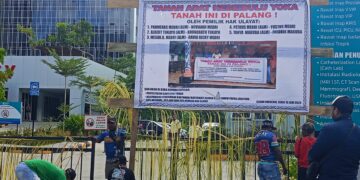
KNPB also cited the arrest of civilians in Intan Jaya Regency, Central Papua, by Indonesian military personnel on May 30 and 31. The organization further highlighted the appropriation of customary lands belonging to indigenous communities in Batu Merah Village, Kimaam District, Merauke Regency, South Papua, as well as in the Metemani–North Kokoda area and the Malamoi customary territory in Sorong and South Sorong Regencies, Southwest Papua, for the development of National Strategic Projects (PSN).
Among the incidents listed by KNPB were the alleged placement of explosives at the Sion Jaindepa Evangelism Post Church in Intan Jaya on June 2, the seizure of land for the construction of a military post in Kali Biru, Dekai, Yahukimo, on June 5, and the expansion of military posts throughout urban areas, villages, and forests near civilian settlements in Nduga Regency, Papua Highlands.
The organization also referred to the alleged bombing of civilian settlements in Melagi District, Lanny Jaya Regency, Papua Highlands, which reportedly resulted in the death of an 18-year-old teenager. KNPB further reported the arrest and alleged torture of four civilians in Yahukimo on June 10 and the arrest of another civilian on June 17.
In addition, KNPB alleged that Indonesian military personnel burned civilian homes in Yahukimo on June 11. The organization also cited a bombing and shooting incident that reportedly left two civilians critically injured and triggered further displacement in Danggoa Village, Intan Jaya Regency, on June 18.
KNPB further referred to an alleged drone bombing in West Sinak, Puncak Regency, Central Papua, on April 6 and the arrest of four civilians and displaced persons by Indonesian military personnel in Maybrat on June 2.

The organization stated that the ongoing armed conflict in Papua has continued to drive an increase in the number of internally displaced persons (IDPs). Based on reports from Human Rights Monitor, KNPB noted that the number of conflict-related IDPs in Papua had reached approximately 107,039 people by March 2026. According to a subsequent report issued on June 10, 2026, that figure had risen to 122,931.
KNPB argued that arbitrary arrests, abductions, shootings of civilians, bombings in civilian areas, intimidation of humanitarian activists, and the seizure of customary lands constitute violations of both Indonesian law and international legal standards. The organization cited Indonesia’s Human Rights Law (Law No. 39 of 1999), the Human Rights Court Law (Law No. 26 of 2000), the 1949 Geneva Conventions, and principles of International Humanitarian Law concerning the protection of civilians during armed conflict.
The organization also referred to the fundamental principles of the laws of war, including the principles of distinction between combatants and civilians and proportionality in the use of force. In addition, KNPB cited the Universal Declaration of Human Rights (UDHR), the International Covenant on Civil and Political Rights (ICCPR), ratified by Indonesia through Law No. 12 of 2005, and the Convention Against Torture (CAT), ratified through Law No. 5 of 1998.
According to KNPB, the excessive use of armed force against civilians in conflict areas could amount to crimes against humanity and serious violations of international humanitarian law.
KNPB also expressed appreciation for filmmakers Dandhy Laksono and Cipri Dale, producer Victor Mambor, and organizations including Jubi, Pusaka Bentala Rakyat, Greenpeace, and Watchdoc for the documentary Pesta Babi – Colonialism in Our Time. KNPB said the film had drawn public attention to humanitarian conditions and structural issues in Papua, including armed violence, civilian displacement, customary land dispossession, natural resource exploitation, the marginalization of Indigenous Papuans, and various forms of alleged human rights violations experienced over decades.
The organization condemned what it described as a military approach in civilian areas across Papua, particularly in Puncak, Intan Jaya, Tembagapura, Yahukimo, and other conflict-affected regions. KNPB called on the Indonesian Government to allow greater access for national and international media, humanitarian organizations, and independent international mechanisms to investigate alleged human rights violations in Papua. It also urged the government to end arbitrary arrests, abductions, torture, intimidation, and acts of violence against civilians, while halting the use of explosive weapons and other methods of warfare in civilian areas.
Furthermore, KNPB called for an end to the criminalization and intimidation of humanitarian activists, human rights defenders, journalists, students, and political activists. The organization encouraged Papuans and Indonesians alike to build humanitarian solidarity and engage in peaceful dialogue in response to the crisis. It also urged churches, humanitarian organizations, non-governmental organizations, and international civil society groups to strengthen support for victims of armed conflict and internally displaced persons in Papua.
KNPB further called for an end to the armed conflict between the West Papua National Liberation Army-Free Papua Movement (TPNPB-OPM) and Indonesian security forces through peaceful dialogue facilitated by a neutral third party. The organization urged the state to guarantee the protection of Indigenous Papuans and their rights to customary lands, territories, and natural resources in accordance with national and international legal standards. It also appealed to the international community, including the United Nations, to pay greater attention to the humanitarian and human rights situation in Papua.
Finally, KNPB reaffirmed its political position in support of the Papuan people’s right to self-determination through what it described as a peaceful, democratic, and internationally supervised referendum. (*)










Discussion about this post