




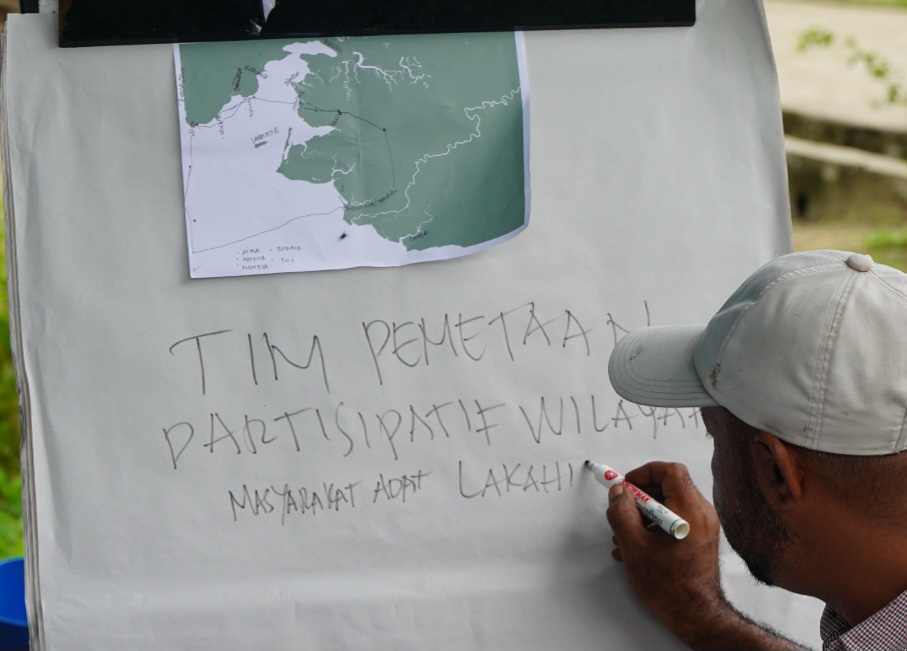
Sorong, Jubi – Head of Research and Innovation at the Southwest Papua Provincial Development Planning, Research, and Innovation Agency (Bapperida), Frengky Albert R.M. Saa, said participatory mapping is a strategic approach to resolving various agrarian conflicts in Southwest Papua Province.
He said agrarian conflicts in the newly established autonomous province are closely related to natural resource management, recognition of customary territories, and development dynamics.
According to Saa, investments in plantations, forestry, mining, and infrastructure development often create disputes involving the government, companies, and Indigenous customary law communities.
In such circumstances, participatory mapping is considered an important approach to fostering dialogue, clarifying customary territorial boundaries, and creating fairer and more sustainable conflict-resolution mechanisms for local communities in Southwest Papua.
Saa said Indigenous communities in Southwest Papua maintain strong historical, spiritual, and social ties to their customary lands.
Land is not merely viewed as an economic asset but also as a cultural identity and ancestral heritage that sustains Indigenous communities across generations.
As a result, when land is taken over without the consent of Indigenous communities, conflicts that arise concern not only ownership rights but also dignity, cultural existence, and the sense of justice of Indigenous peoples.
“Therefore, participatory mapping is a strategic tool to ensure that the voices of Indigenous communities are accommodated in the regional development process,” Saa said on Wednesday.

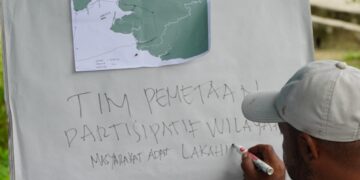
According to Saa, participatory mapping allows Indigenous communities to be directly involved in identifying their customary territories and customary lands.
These include village boundaries, customary forests, sacred sites, and community livelihood resources such as rivers, sago groves, and hunting grounds.
The involvement of Indigenous communities in the process provides social legitimacy to the resulting maps because they are based on local knowledge and collective history.
“With participatory maps of customary territories, the potential for conflicts arising from unilateral claims can be minimized through deliberation and mutual agreements among relevant parties,” he said.
Saa explained that many agrarian conflicts in Southwest Papua have been triggered by weak formal recognition of customary territories that Indigenous communities have occupied and managed for generations.
This situation has led to social tensions, community resistance, and prolonged conflicts that hinder regional development.
Participatory mapping is therefore considered an important instrument for bridging the gap between the state’s administrative system and customary land tenure systems that have been practiced for centuries.
Participatory mapping is also viewed as a means of strengthening customary territorial governance and supporting sustainable development in Southwest Papua.
Through mapping, Indigenous communities can establish spatial zoning based on customary values and ecological functions. Areas designated for customary conservation, water-source protection, community farming areas, and settlements can be clearly identified, enabling more planned and sustainable regional development.
“This approach is in line with sustainable development principles that place local communities as the primary actors in natural resource management,” he said.
Saa added that geospatial technology offers significant opportunities to strengthen participatory mapping in Southwest Papua. The use of GPS, drones, satellite imagery, and Geographic Information System (GIS) applications can help Indigenous communities produce more accurate territorial maps that can serve as supporting documents in the recognition of customary land rights.
At the same time, involving Papuan youth in mapping technologies is an important step toward transforming customary knowledge into digital formats that are more adaptable to technological advancements.
According to Saa, the success of participatory mapping depends on support and collaboration among multiple stakeholders, including local governments, customary institutions, academics, civil society organizations, and churches.
“Local governments have a strategic role in providing policy legitimacy to community mapping results through regional regulations, recognition of customary villages, and integration of customary territorial maps into spatial planning frameworks,” he said.
Academics and research institutions can contribute by providing data, technical assistance, and capacity-building support for communities engaged in participatory mapping.
However, Saa acknowledged that several challenges remain before participatory mapping can fully function as an instrument for protecting Indigenous rights.
These challenges include limited human resources, inadequate funding, conflicts of interest among groups, and the lack of policy synchronization between central and regional governments regarding the recognition of customary territories.
In some cases, community-generated maps have yet to receive full legal recognition, making them vulnerable to being overlooked in development decision-making processes.
For that reason, he said, strong political commitment is required to ensure that participatory mapping becomes a genuine instrument for protecting Indigenous rights rather than merely an administrative formality.
Participatory mapping, he stressed, is not simply about drawing territorial boundaries but also about advancing social justice and recognition of Indigenous customary law communities in Southwest Papua.
“Amid the rapid flow of investment and development expansion in Southwest Papua, recognition of customary territories can no longer be treated as a mere administrative complement,” he said.
He emphasized that Indigenous communities must become the primary subjects in all decision-making processes concerning their customary territories.
Without clear recognition of customary territorial boundaries, the potential for social conflict will continue to recur and become a serious obstacle to sustainable development.
“Agrarian conflict across Papua demonstrate that development which ignores the rights of Indigenous communities only leads to distrust, resistance, and prolonged social tensions.”
Saa said participatory mapping should therefore be regarded both as an instrument for protecting Indigenous rights and as a crucial foundation for creating legal certainty for all stakeholders.
Local governments, he added, need to strengthen their political commitment through regulations that provide genuine recognition of participatory mapping outcomes.
Without strong policy support, community-generated maps risk becoming little more than archived documents, lacking the authority to shape development policies or resolve territorial disputes.
“Participatory mapping is an important step in ensuring that development proceeds in harmony with the protection of Indigenous Papuans’ rights, environmental sustainability, and the strengthening of peace and social stability throughout Papua,” Saa said. (*)











Discussion about this post