




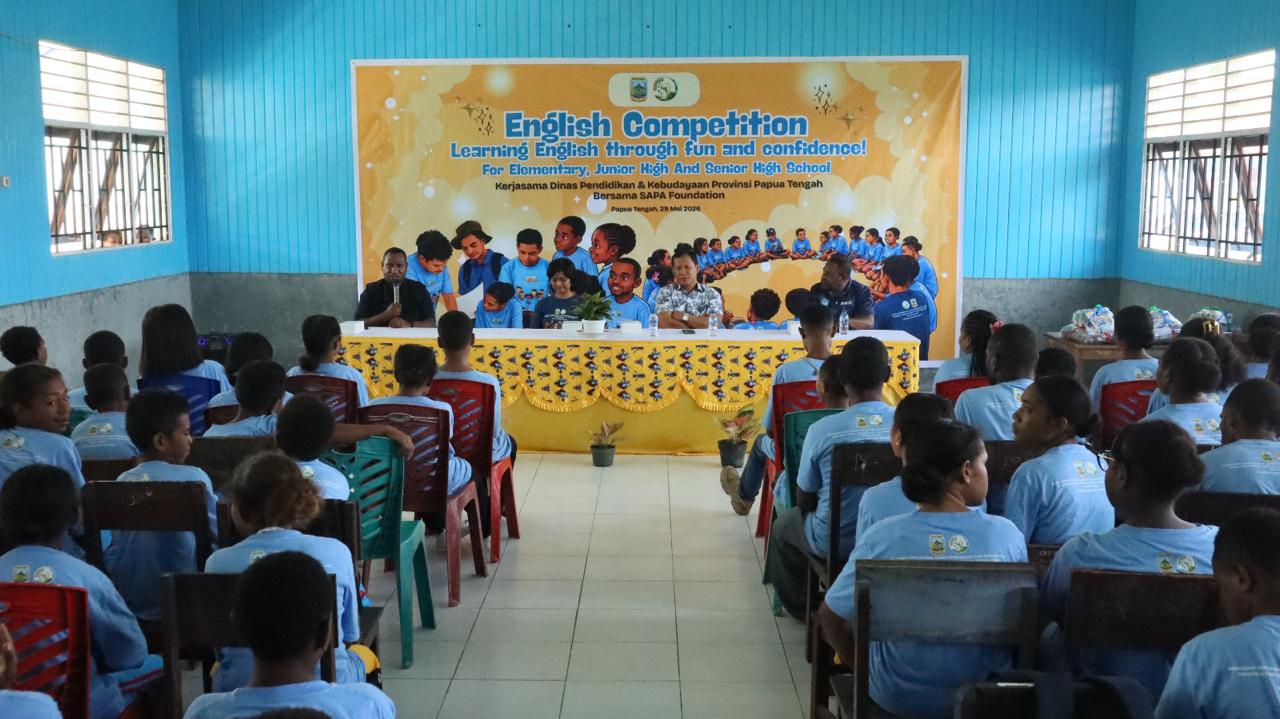
Jayapura, Jubi – An English language skills development program initiated through a partnership between the Syena Ahoro Papua Foundation (SAPA Foundation) and the Central Papua Provincial Education and Culture Office has surpassed its initial target.
Originally designed to reach 875 students across three regencies, the program ultimately attracted 980 participants, reflecting strong enthusiasm from the education sector in the region.
The month-long English course program was conducted in the regencies of Nabire, Dogiyai, and Deiyai. It involved 980 students from elementary, junior high, and senior high/vocational schools as part of efforts to improve educational quality and English proficiency among Central Papua’s younger generation, equipping them to face future educational challenges and global competition.
SAPA Foundation Chairperson Christywella Saroy expressed gratitude for the program’s achievement in exceeding its participant target.
“For one month, SAPA Foundation implemented the English language course program in three regencies of Central Papua—Nabire, Dogiyai, and Deiyai. From an initial target of 875 students, we successfully reached 980 participants from elementary to senior high/vocational levels,” Saroy said in a statement on Thursday.
She added that the program benefited 21 partner schools and had a positive impact on 10 additional schools.
“The program has also provided benefits to 21 partner schools and created positive impacts on 10 other schools,” she said.
According to Saroy, the program’s success demonstrates the strong enthusiasm of students, schools, and local communities for English language learning.
As a result, SAPA Foundation hopes similar initiatives can continue with a longer duration of three to four months, allowing students more time to strengthen their English skills.
Through the collaboration between the Central Papua Provincial Government and SAPA Foundation, it is expected that more young people in Central Papua will gain strong English proficiency, opening wider access to education, information, and opportunities at both national and international levels.
The program aims to improve students’ English-language competency so they are better prepared to pursue higher education and compete in a globalized world.
“Various materials were delivered interactively, covering speaking, listening, reading, and writing skills, and were enriched with practical exercises to make learning easier to understand,” Saroy said.
Before the courses began, SAPA Foundation organized a three-day Capacity Building In-House Training for Tutors and Teachers attended by 16 tutors and eight teachers. The training was designed to equip educators with more interactive, engaging, and student-friendly teaching methods.
At the end of the training, participants demonstrated the methods they had learned through micro-teaching sessions.
Following the training, tutors and teachers were assigned to program sites in Nabire, Dogiyai, and Deiyai to conduct English language courses in target schools.
To ensure the courses did not disrupt regular classroom activities, classes were held outside normal school hours.
Throughout the program, students attended English lessons daily, with each session lasting three to four teaching periods over a span of three to four weeks.
Using an interactive and enjoyable learning approach, students were given opportunities to strengthen their foundational English skills, including vocabulary acquisition, pronunciation, sentence construction, and speaking ability.
The intensive schedule was expected to help students develop and apply their English skills more quickly in everyday life.
Head of the Data and Education Facilitation Section at the Central Papua Provincial Education and Culture Office, Medelky Anouw, said the program represents an early step in preparing students for upcoming national policies aimed at strengthening English language instruction in schools.
The Ministry of Primary and Secondary Education plans to make English a compulsory subject in schools, beginning at the elementary level in 2027.
To anticipate the policy, the Central Papua Provincial Government, through the Education and Culture Office, launched the course program as a foundational initiative.
“We believe that English is a window to the world. Schoolchildren need to be equipped with English skills so they can compete at both the national and global levels,” Anouw said.
As part of the program evaluation, SAPA Foundation also organized English competitions in all three regencies to assess students’ progress after one month of English instruction.
The competitions featured several categories, including Flash Card Race, Spelling Bee, Vocabulary Race, Sentence Building, and Picture Talk.
Through these activities, students were not only tested on their English proficiency but were also encouraged to become more confident in actively using the language.
Participants responded positively to the program, saying they gained valuable new knowledge and felt more confident speaking English.
“I used to be afraid of speaking English, but now I’m much more confident. The teaching methods were fun and easy to understand,” said one student participant from Nabire.
SAPA Foundation is committed to improving educational quality, developing youth capacity, and empowering communities across Papua through education, training, skills development, and entrepreneurship programs.






Discussion about this post