





Sorong, Jubi – Conservation organization Terra Abadi Papua says its presence in Southwest Papua is intended to strengthen collaboration between government institutions, local communities, and environmental organizations to support the conservation and sustainable management of terrestrial and marine ecosystems across the Bird’s Head Region of Papua, particularly in Raja Ampat, which is renowned for its rich biodiversity.
Southwest Papua Governor Elisa Kambu emphasized that development must not come at the expense of environmental sustainability.
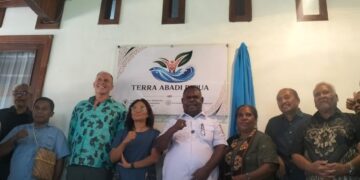
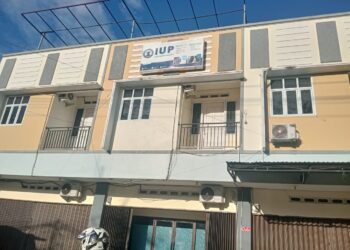
Kambu made the remarks while inaugurating the Terra Abadi Papua office on Jalan Selat Obi Kilometre 9.5 in Sorong City on Wednesday (June 24, 2026).
He said that building Southwest Papua is not only about developing infrastructure and promoting economic growth, but also about ensuring that the region’s natural wealth is preserved for future generations.
“Our aspiration to advance Southwest Papua is a shared dream. It is impossible for the government to achieve it alone. The more parties involved, the better. Today we welcome a new partner, Terra Abadi Papua, which works in the field of environmental conservation,” Kambu said.
According to Kambu, the government cannot single-handedly protect a region as vast as Southwest Papua, particularly given its complex environmental challenges.
For that reason, he described the presence of Terra Abadi Papua as a strategic step toward strengthening conservation efforts that place local communities at the center of protecting Papua’s natural environment.
He noted that Southwest Papua possesses extraordinary natural wealth, including well-preserved forests, biodiversity-rich seas, and Indigenous communities that have lived in harmony with nature for centuries.
“All of this must be protected together. The government cannot work alone. We need collaboration from everyone who cares about the future of our environment,” he said.

Kambu stressed that all forms of development must be carried out carefully to avoid damaging the ecological balance that has been preserved across generations.
The Southwest Papua Provincial Government, he said, is committed to ensuring the long-term conservation of both marine and terrestrial ecosystems throughout the province.
“We warmly welcome the presence of Terra Abadi Papua. We hope the organization will become a partner that works closely with communities to protect this critically important region,” he said.
Kambu added that the provincial government will continue strengthening policies that support environmental conservation. However, he emphasized that effective policies must be accompanied by practical programs that directly address community needs.
While governments play an important role in developing regulations and policies, he said, successful environmental protection ultimately depends on implementation in the field.
The provincial government hopes Terra Abadi Papua can assist communities, strengthen their capacity, and implement programs that have a meaningful impact on the sustainable management of natural resources.
“We have already discussed a number of ideas with Terra Abadi Papua regarding stronger environmental governance and the development of sustainable tourism. These ideas will be further reviewed to ensure that economic development does not become a threat to the environment,” Kambu said.
Terra Abadi Papua Executive Director Meity Mongdong expressed appreciation to the Southwest Papua Provincial Government for creating space for collaboration among various stakeholders committed to environmental sustainability.
According to Mongdong, Terra Abadi Papua was established with a broad vision of ensuring that Southwest Papua’s natural resources remain a long-term source of livelihood for local communities.
“We hope to become a trusted partner of the government in supporting development programs, particularly by ensuring that natural resources in Southwest Papua remain sustainable and continue to provide food, livelihoods, and economic opportunities for communities over the long term,” Mongdong said.
She explained that Terra Abadi Papua’s conservation approach goes beyond environmental protection alone and seeks to ensure that communities receive sustainable economic benefits from the natural resources they depend upon.
The organization believes conservation and community welfare should not be treated as separate objectives. When the environment is well protected, communities can also enjoy greater and more sustainable economic benefits.
“That is why we want to build management models that maintain a balance between environmental protection and community needs,” she said.
Mongdong explained that over the next three to five years, Terra Abadi Papua will focus its activities on Raja Ampat, which is currently facing a number of serious challenges requiring collective attention.
One of the most visible challenges, she said, is the rapid growth of tourism without corresponding improvements in environmental management.
If not properly addressed, she warned, a sector that has long served as a pillar of the local economy could eventually become a threat to the sustainability of the natural resources on which it depends.
“Tourism, which has long been the backbone of Raja Ampat’s economy, is beginning to show signs of threatening the very resources that support it,” Mongdong said.
She emphasized the need for effective regulations and responsible practices to ensure that tourism delivers long-term economic benefits for both communities and government.
Coastal development, she added, also deserves special attention because of its direct impact on marine ecosystems, which are among Raja Ampat’s greatest assets.
Development in coastal areas must be carefully managed, she said. Otherwise, the consequences will be felt directly by marine ecosystems that support local livelihoods.
According to Mongdong, Terra Abadi Papua will promote an integrated management approach that links the protection of terrestrial and marine ecosystems, recognizing that both are interconnected.
“We cannot protect the ocean without protecting the forests. Nor can we protect coastal areas without paying attention to the land. That is why our approach is integrated management that views the entire landscape as a single ecosystem,” she said.
Terra Abadi Papua also plans to expand its activities to other areas across the Bird’s Head Region of Papua, including South Sorong, Tambrauw, Fakfak, and Kaimana. However, Raja Ampat will remain its primary focus as a living laboratory for conservation and sustainable development.
Meanwhile, Terra Abadi Papua founder Frida Tabitha Klasim said Indigenous communities must play a central role in determining the future of Raja Ampat rather than becoming mere spectators on their own ancestral lands.
She stressed the importance of equipping Indigenous communities with knowledge and skills so that the benefits of conservation initiatives continue even after specific programs have ended.
“Communities must absorb every learning process, whether related to conservation, Indigenous economic development, women’s economic empowerment, or natural resource governance,” Klasim said.
She added that decision-making at the village level must be participatory and involve all members of the community, including Indigenous women, who have often been excluded from development processes.
According to Klasim, Indigenous women play a crucial role in protecting families, culture, land, and the future of Raja Ampat.
As the founder of Terra Abadi Papua, she said she carries a significant responsibility to ensure the organization remains faithful to its original vision of promoting conservation that supports Indigenous communities and encourages self-reliance for the common good.
“That is the commitment we will continue to uphold in safeguarding Raja Ampat and Papua in the future. We want to ensure that development in Papua does not come at the expense of the natural environment that sustains local communities,” she said.
Klasim concluded that collaboration among government institutions, Indigenous communities, conservation organizations, academics, and other stakeholders must continue to be strengthened to ensure Papua’s natural wealth is preserved and passed on to future generations. (*)










Discussion about this post