





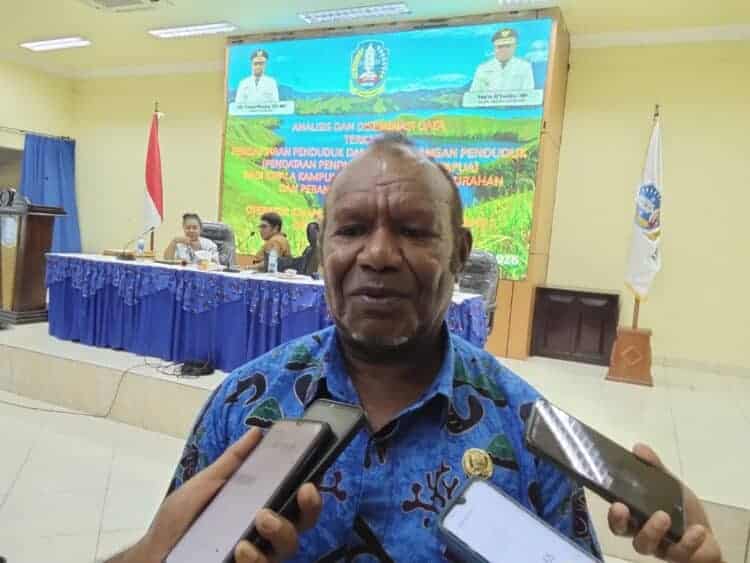
Sentani, Jubi – The Jayapura Regency Civil Registry Office (Disdukcapil) has begun conducting direct field data collection across districts to update population records for the second quarter of 2026.
Acting Head of Disdukcapil Jayapura Regency, Yorem B. Wanimbo, said the initiative also prioritizes verifying data on Indigenous Papuans (OAP) to ensure that social assistance and government programs are accurately distributed.
“We have observed that social assistance has not been evenly distributed. Through this data collection, we want to ensure that the rights of Indigenous Papuans are truly received by those who are entitled,” Wanimbo said on Thursday (April 9, 2026).
He explained that the data update is a continuation of the first-quarter population data verification carried out in coordination with the General Elections Commission (KPU) of Jayapura Regency.
*****************
Jubi.id adalah media yang berbasis di Tanah Papua. Media ini didirikan dengan sumberdana masyarakat melalui donasi dan crowd funding. Dukung kami melalui donasi anda agar kami bisa tetap melayani kepentingan publik.
*****************
“We are now entering the second quarter. Within family cards, there are often changes—such as deaths and births—that are not reported by neighborhood or village authorities,” he said.
According to Wanimbo, the office is implementing a proactive “outreach” approach by visiting districts directly to assist residents with civil registration services, particularly those living in remote areas.
This initiative is aimed at reducing the financial burden on residents who would otherwise need to travel long distances to access Disdukcapil services, especially in remote districts such as Airu.
The program will begin in April, starting with nearby districts in development zones one and two, including Sentani, East Sentani, and West Sentani.

Wanimbo added that Disdukcapil has partnered with several institutions, including BPJS and the social affairs office, while also coordinating with the Jayapura Regency Legislative Council (DPRK) to consolidate and streamline population data.
The effort will involve district heads, village leaders, neighborhood units, and health facilities to ensure accurate data collection.
The data collection process is targeted for completion within approximately four months, from April to August 2026.
However, Wanimbo acknowledged several technical challenges in the field, including limited internet access and unstable network signals during service delivery in districts. To address this, the office plans to propose additional network support to local authorities.
“We will continue providing services to the public while conducting evaluations and improving the system, so that services are not disrupted,” he said.
Meanwhile, a resident of Kemtuk Gresi District, Antoneta Magon, welcomed the initiative, praising the government’s decision to conduct direct data collection in villages and districts.
“This will automatically help and make things easier for us, so we don’t have to spend time and money traveling to take care of administrative matters. I think the outreach system is a very good policy for us,” she said. (*)
Iklan Layanan Masyarakat ini Dipersembahkan oleh PT. Media Jubi Papua










Discussion about this post